
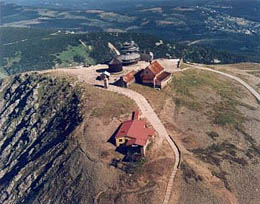
The oldest building on Sněžka is the rotunda chapel of Saint Lawrence
 |
The construction of the post office began after delays at the end of this May. However, the first works began in the summer of 2006 with the modification of the foundations of the Czech lodge, which will serve as the background for the post office operations. The design of the new landmark at the summit was created by architects Martin Rajniš and Patrik Hoffman. The building consists of wooden parts reinforced with steel rods and glass panes, which can be covered with wooden shutters. The post office seems to float above the ground, tethered to it by just a few pillars.
The Czech post office on Sněžka stamped its first letters and postcards with a round stamp as early as September 1899. In 1938, after the German army occupied the Sudetenland, the post office was closed and its operations did not continue even after the war. Services on Sněžka were only restored in 1995 by the former postmaster from Velká Úpa, Jaroslava Skrbková. She repaired a small house for the post office, which in the 1930s housed a snack kiosk. Skrbková is also the investor in the construction of the new building.
The new post office stands in the place where the Czech lodge used to be. However, its dilapidated structure had been closed since 1990 due to the discharge of contaminated wastewater, and demolition was carried out in 2004. The lodge was built in 1868 by the innkeeper Herman Blaschke from Malá Úpa in Trutnov. It was originally intended to serve only in the summer season. In 1884, 1900, and 1949, the building was gradually surrounded by additional extensions and became famous for its dance events. The Czech lodge also provided accommodation.
The oldest building on Sněžka is the rotunda chapel of St. Lawrence, the construction of which was initiated by the Silesian nobleman Kryštof Leopold Schaffgotsch. It was consecrated in 1681. After the dissolution of monasteries in Prussia, it served as an inn and dormitory until 1850, when the chapel's tenant, Friedrich Sommer from Silesian Teplice, built the first Prussian lodge on the northern side of the summit plateau, which burned down after seven years, just like the second Prussian lodge, which was struck by lightning in 1862. Only the third lodge at the same location served until 1967.
In 1824, a fundamental trigonometric point was added to the chapel of St. Lawrence, whose precise positioning was taken care of by the then Imperial and Royal Military Geographic Institute in Vienna. After costly astronomical and geodetic measurements, the stone mound at the top of Mount Sněžka became one of the fundamental points of the network that has served for nearly 200 years for both mapping purposes and for detecting the movement of the Earth's crust.
Shortly before 1900, a meteorological station with an 18-meter-high wooden tower was added to both lodges, which became a prominent object on Sněžka. In 1976, meteorologists moved to the new Polish lodge at the site of the original Prussian lodge made up of three connected structures resembling flying saucers. The wooden structure of the original station was thus possible to disassemble and transport down to the valley in the 1990s.
A milestone in the history of Sněžka was also the accessibility of the summit to less physically fit tourists. Until the mid-20th century, people had to walk up. The construction of the cable car was divided into two parts: from Pec pod Sněžkou to Růžová hora, passengers first traveled in January 1949, the section to the summit was commissioned in November of the same year. Although the original facility is quite outdated, discussions about the design of the new cable car (where it should lead and what the stations should look like) have been ongoing unsuccessfully since 1990.
The English translation is powered by AI tool. Switch to Czech to view the original text source.
0 comments
add comment