
To our schools and jobs by bike
"We want to ride to our schools and jobs every day – by bike and safely. Let us do it!"
This is the message from the cycling community of Brno. Nearly two hundred and fifty representatives rode through the streets of Brno on the afternoon of Wednesday, September 22, 2011. It was the Great Bike Ride, traditionally organized not only in the autumn, in conjunction with the International Car-Free Day and European Mobility Week, but also in the spring by the civic association Brno on a Bike.
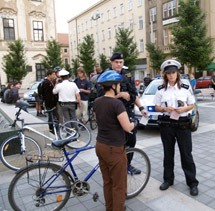
The column of cyclists, which set off from Moravské náměstí after 5 PM, first rode down the newly repaired Joštova street. According to the Cycling Transport Master Plan approved by the Brno City Council in the autumn of the previous year, a cycling corridor was supposed to be marked here. Joštova has been completely renovated, but the cycling corridor has been forgotten. Instead, there is a sign prohibiting the entry of all vehicles, including cyclists. The bike ride continued through Husova and Starobrněnská streets. Crossing Zelný trh and along Masarykova street, they reached náměstí Svobody. In the meantime, the city center is closed to cyclists every day from 9 AM to 5 PM. Therefore, those with jobs in this area must "push" their bikes to work every day, or consider that they are violating traffic regulations in the eyes of the Brno police. Unfortunately, Brno has not yet joined the good practice of many other cities like Prague, Olomouc, Hradec Králové, or České Budějovice, where cyclists are allowed to pass through pedestrian zones without any time restrictions. While passing through Kounicova street, cyclists were stopped by the Czech Police to inform participants that they were violating traffic regulations. The cyclists then continued on – down Kotlářská and Lidická back to Moravské náměstí. Soon after, eight police cars arrived with their lights on. Police representatives began recording the participants of the ride and subsequently started checking their IDs. In the meantime, representatives of the Brno press and Czech Television arrived. After several dozen minutes, the police left without any explanation.
The reason for organizing bike rides is to publicly support the idea that Brno should be friendly to pedestrians and those who use bicycles as a means of transport. "It's not just about protesting, but also showing the public and politicians that people are traveling by bike in the city and that it is necessary to ensure good conditions for safe cycling," says Martin Špaček, a member of the civic association Brno on a Bike. And when traffic regulations are violated during bike rides – most often running a red light – it happens due to the length of the cycling peloton and the concern that a car might get in between cyclists and endanger them," Špaček explains further.
The organizers and participants of the bike rides strive for minimal violations of traffic regulations, but unfortunately it happens. The fact is that the streets of Brno are not sufficiently safe for cyclists. Cyclists are still not perceived as a significant component of transport in the eyes of most local politicians. Although the aforementioned Cycling Transport Master Plan was approved a year ago, its implementation, as well as the "pro-cyclist" promises made by Brno politicians before the elections, is failing. The civic association Brno on a Bike organizes bike rides to express the civic discontent of many Brno residents with serious shortcomings in the city's traffic policy conception and is ready to address these issues with the city of Brno, all the institutions of its management, the Czech Police, and the Municipal Police. If the attitude and approach of many politicians, who do not differentiate in their terminology between recreational bike paths and traffic measures in the form of designated lanes for cyclists, do not change, the conditions for cyclists in Brno, the second-largest city in the Czech Republic, will continue to be in such a desperate state compared to other, paradoxically much smaller Czech cities. The dissatisfaction of many citizens will thus not disappear and will continue to grow. Until then, the Brno bike rides will not be a "joyful celebration of free movement in the city," but unfortunately, primarily an expression of disagreement with the unresolved cycling conception of the city and a wondering about why the political representation of the Brno City Hall does not fulfill its pre-election promises.
More information >
This is the message from the cycling community of Brno. Nearly two hundred and fifty representatives rode through the streets of Brno on the afternoon of Wednesday, September 22, 2011. It was the Great Bike Ride, traditionally organized not only in the autumn, in conjunction with the International Car-Free Day and European Mobility Week, but also in the spring by the civic association Brno on a Bike.
 |
| Photo: Lukáš Černý |
The reason for organizing bike rides is to publicly support the idea that Brno should be friendly to pedestrians and those who use bicycles as a means of transport. "It's not just about protesting, but also showing the public and politicians that people are traveling by bike in the city and that it is necessary to ensure good conditions for safe cycling," says Martin Špaček, a member of the civic association Brno on a Bike. And when traffic regulations are violated during bike rides – most often running a red light – it happens due to the length of the cycling peloton and the concern that a car might get in between cyclists and endanger them," Špaček explains further.
The organizers and participants of the bike rides strive for minimal violations of traffic regulations, but unfortunately it happens. The fact is that the streets of Brno are not sufficiently safe for cyclists. Cyclists are still not perceived as a significant component of transport in the eyes of most local politicians. Although the aforementioned Cycling Transport Master Plan was approved a year ago, its implementation, as well as the "pro-cyclist" promises made by Brno politicians before the elections, is failing. The civic association Brno on a Bike organizes bike rides to express the civic discontent of many Brno residents with serious shortcomings in the city's traffic policy conception and is ready to address these issues with the city of Brno, all the institutions of its management, the Czech Police, and the Municipal Police. If the attitude and approach of many politicians, who do not differentiate in their terminology between recreational bike paths and traffic measures in the form of designated lanes for cyclists, do not change, the conditions for cyclists in Brno, the second-largest city in the Czech Republic, will continue to be in such a desperate state compared to other, paradoxically much smaller Czech cities. The dissatisfaction of many citizens will thus not disappear and will continue to grow. Until then, the Brno bike rides will not be a "joyful celebration of free movement in the city," but unfortunately, primarily an expression of disagreement with the unresolved cycling conception of the city and a wondering about why the political representation of the Brno City Hall does not fulfill its pre-election promises.
More information >
On behalf of the civic association Brno on a Bike: Mgr. Martin Špaček, Josef Patočka
The English translation is powered by AI tool. Switch to Czech to view the original text source.

0 comments
add comment