
Disconnected. Connected! 2006 architecture and djing
According to the organizers, the Cycle Disconnected. Connected! is one of the curatorial projects of CCEA and follows its effort to promote architecture, the young architectural generation, advocating for an attractive and understandable form of architecture presentation towards a non-expert public, and finding ways to popularize architecture through other artistic disciplines and their possibilities.
This year's third edition (the first took place in 2004 and was subtitled Architecture and Animation, the second in 2005 with the subtitle Architecture and Advertising Photography) has successfully fulfilled this statement by the creators of the installation. Within the limited spaces of CCEA, they managed to place a truly interesting installation that clearly speaks to each visitor.
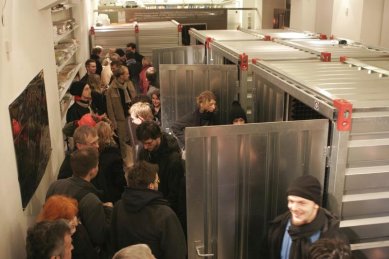
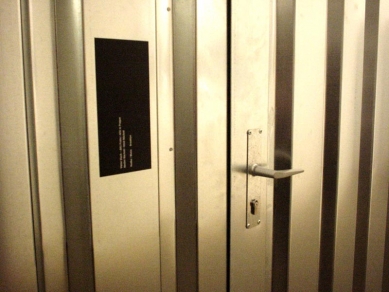
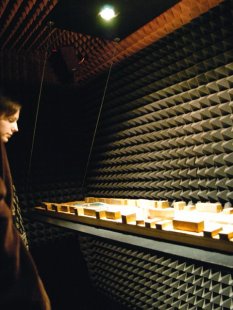
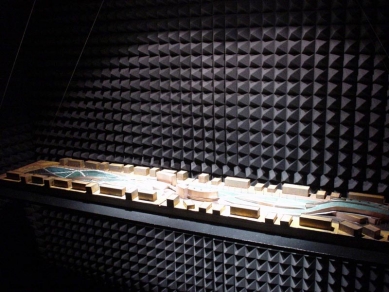
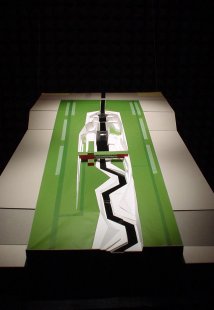
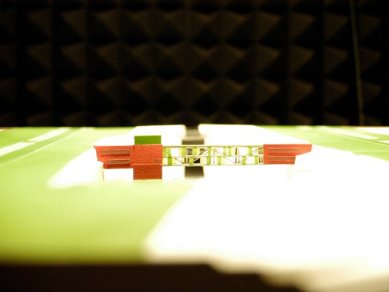
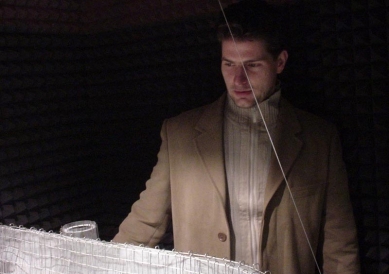
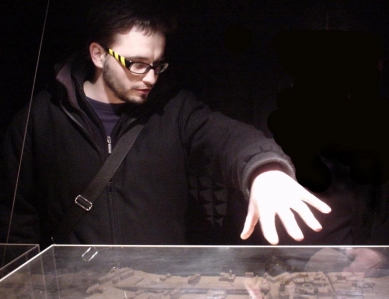
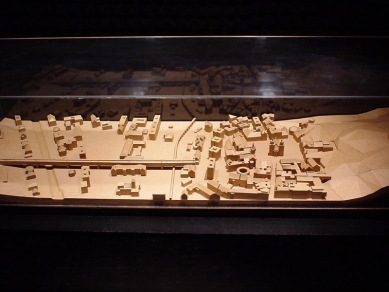
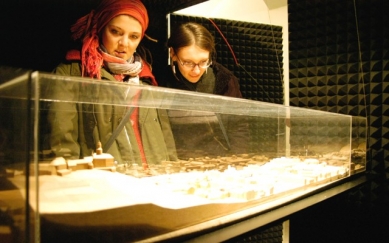
In the gallery, there are 6 silver shipping containers from which the sounds of the installation faintly reach your ears. If you open the doors of one of the boxes, you find yourself in a small sanctuary. The walls, lined with black acoustic panels, perfectly separate you from the outside world. In the center of the box stands an impressively illuminated model, and you can peacefully listen to the music flowing from the speakers and let your imagination drift as you visualize walking through the real form of the exhibited architecture.
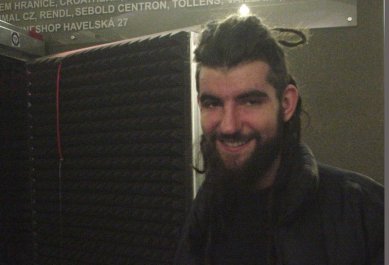
6 quality projects in 6 small private sanctuaries. It is almost surprising how strongly music can influence our perception of the world. Architects, according to one of the participating graduates (Viktor Vlach), generally do not deal with its impact in the designed object. We are not only talking about music itself, but we can discuss all acoustic influences that can occur during the use of the building.
The project works with diploma projects of architecture students, and for the first time this year, graduates were contacted through a call (in previous years, students were selected from exhibitions of individual schools), to which 25 former students responded. Among their works, 6 projects were selected, with emphasis primarily on their philosophy. Preference was given to projects that sought to find answers to certain questions; the question of their actual realization was less important.
The following projects were selected:
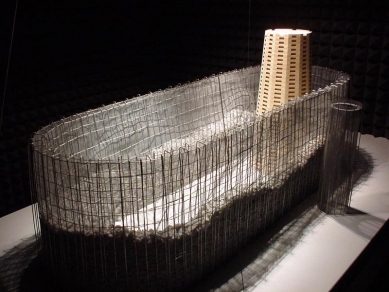
The oval perimeter wall of the temple visually resembles a ship settled in the landscape. The horizontal placed in the landscape is complemented by the vertical of the tower. The central structure combines two archetypes of sacred architecture: a bell tower and a chapel. The nave of the temple is not roofed. It consists of perimeter walls woven from fine steel rods and the blue sky.
The stones are brought to the network by the pilgrims themselves, gradually building the church's own walls. It is a manifestation of a sort of act of forgiveness.
CCEA Comment
The church itself does not address the conservation of nature but the salvation of man in nature. We like to choose projects that have a strong idea at first glance, regardless of the realizability or non-realizability of the work.
At a time when architecture is under pressure from investors and often nonsensical regulations from authorities, when architecture distances itself from art, this project shows a way where the pilgrim becomes a builder, playing a role that is written into one of the fundamental instincts of man: “building.”
We selected this project not only because of its original idea, which transforms the spiritual level into action, but also due to its high level of presentation. In the presentation, the author does not mention details and technical specifics, which brings freshness to the whole project and does not tire with unnecessary technicality.
Jakub Tejkl (AAAD Prague)
The author stated that people began to spontaneously offer support for his project; he was surprised by the interest the project generated. Thus, this fall, his book dedicated to this topic should be published as part of the publication activities of the school (AAAD Prague).
Jakub Tejkl currently works in the studio of Bára Škorpilová, mainly on hotel projects around the world.
The urbanistic-architectural project aimed to create a settlement for 150 refugees and staff. The solution had to meet ecological and economic requirements but should primarily present a functioning integration system in the host country, providing not only accommodation but also opportunities for daily activities, work, education, and rest. The settlement should operate independently and be self-sufficient, especially in ecological terms.
This project strives primarily to bring to light the questions that the issue of refugees raises among us. The entire proposal was subsequently presented to the state administration thanks to the initiative of people who engage with this issue at a professional level, but it received negative feedback from the editor-in-chief of the magazine ERA 21, Osamu Okamura, who was invited as an expert advisor. He pointed to the tendency for the ghettoization of refugees, and as a result, the entire project was dismissed.
CCEA Comment
The diploma thesis opens one of today’s acute problems. For three reasons, it evokes strong optimism in us: the thoroughness with which the pre-diploma seminar was processed, the depth of the topic, and the author’s ability to “survive” five years of schooling, in which students of ZAN-* are attacked by standards, toilet dimensions, simple shapes, clean and logical architecture that has a “strong” idea, and truthful use of materials.
He “survived” since it seems that the proposed design meets all norms and technical parameters, yet at the same time is architecturally different from what is taught at CTU.
The decision to select Radoslav Dvořák’s work was determined by the author’s determination to name the taboo properly based on the analysis into which he invested considerable energy. An aesthetic based on a cultural mix, transformed into a primal dwelling, may not excite us, but the “strong” idea is the foundation of the project.
*ZAN - Fundamentals of Architectural Design - studio work of the first year at CTU, where students very often “design” buildings without anyone questioning the meaning of buildings, construction, and architecture.
Radoslav Dvořák (CTU FA, Prague)
He currently lives in a small village in the Slovak Rudohorie, where, according to him, he enjoys freedom, engaging not only in regular activities like carrying and chopping wood but also in sculpture and furniture making, and occasionally earns a living through graphics.
The Podkrušnohorská basin, covering 20 x 70 km, extends between Kadaň and Ústí nad Labem. Various specialists should participate in the landscape revitalization project. Ecologists, natural scientists, foresters, sociologists, and architects should also play a significant role. The diploma thesis addresses one part of the project: the architectural aspect, also attempting to delve into issues of ecology.
The author seeks to find an alternative to established solutions, which could be more advantageous from both ecological and economic perspectives. Her original approach to solving the issue will be offered to current landowners despite the realization opportunity being hindered by existing contracts with private firms that are supposed to carry out the reclamation of the given area in a predetermined manner within 40 years.
CCEA Comment
Věra Šatochinová’s proposal is the opposite of the currently established procedure, where the reclamation of landscape damaged by extraction is dealt with by camouflaging what we have done. By creating a maximally energy-independent system to revitalize the devastated area, the scars are transformed into advantages. The inclusion of this project in the selection was influenced not only by the appreciation of the overall solution to the problem but also by the assumption that the attitude of large planners will change over time, and that in 2038 we will consider similar projects as a matter of course.
Věra Šatochinová (CTU FA, Prague)
She currently works in the atelier Z-architects and thus closely collaborates with Igor Kovačevič and Ivette Vašourková, the initiators and main driving forces behind CCEA.
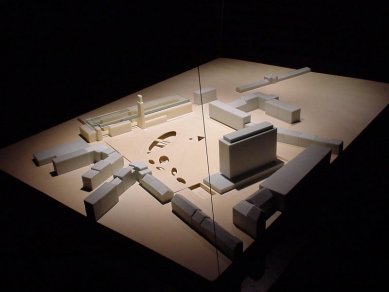
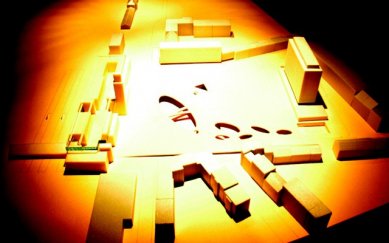
Urbanistic design of a new center for the Slavonín-North site in Olomouc. The project addresses the solution for a park, town hall, city houses, and commercial zone.
CCEA Comment
An interesting example of how even in megastructures, which are mostly public investments, a respected real program and the real needs of the area can combine while maintaining sufficient space for leisure and its inhabitants. The architecture of individual objects is clear, and the function is identifiable even from the exterior. We decided to select this project because the confrontation between raster development and organic layouts does not seem like a cliché, but rather a functional coexistence.
Lukáš Fišer (VUT FA, Brno)
He currently works in the 3D HOUSE studio in Stockholm. For this reason, he was not present at the exhibition opening.
The theme of the diploma thesis is the ideal plan for the author's hometown, in this specific case, Náchod. A city that the author has known for a quarter of a century, aware of its mistakes and shortcomings. The city is perceived as a living organism. The goal of new urbanism is to make Náchod a healthy individual, a manly city, or at least guide successors to think, which will eventually heal the organism.
The most striking element of the entire proposal, a kind of manifesto, is the placement of the “log” of the new series of shops in the center of the village, which naturally creates a lively bridge between the center of Náchod and nearby neighborhoods. Attention is particularly drawn to the shape, atypical for this type of building.
Given that the representatives of the city of Náchod did not provide any support to the author during the preparation of the project solution nor in locating the materials, the author does not intend to familiarize them with the results of his work.
CCEA Comment
The author has developed a series of solutions that change the character of the city. Simple forms of cylinders and prismatic shapes are transformed into buildings that enrich the city with functions it has so far lacked.
The author’s confidence in working with the simplest archetypes may face considerable difficulties in confronting the reality of authorities, investors, municipalities, the public, and the current poor urbanism. However, it establishes a platform for discussion. We included this project in the selection as a manifesto of contemporary Czech urbanism.
Viktor Vlach (AVU Prague)
He currently works in the Karlín studio "třiarchitekti." He, together with Vladimír Vašut, founded the informal association "under-construction architects."
The Hradec railway station designed by Václav Rejchl was one of the most generous transport buildings upon its completion. However, today, railway transport has lost its privileged position. Current designs do not reflect this fact and extensively occupy further areas of the city's territory for poorly located bus stations. The aim of the diploma thesis is a proposal for a compact terminal for all types of truly integrated transport, aiming to enhance the significance of the cultural monument.
With his design, the author aimed to reflect experiences with bus terminals across Europe he had the opportunity to familiarize himself with. He tries to find an alternative to the continuously repeated solutions in our country, which strictly correspond to the relevant norms.
CCEA Comment
An interesting approach in which the needs of the public as voters and the public as consumers intertwine. The intertwining of public and commercial functions is a necessity whose solution we cannot avoid in the future. Petr Štefek’s project transforms this challenge into interesting contemporary architecture, situated in the “underground,” where the mix of functions serves as an intriguing social experiment. Besides the architectural expression, the timeliness of the problem also contributed to the selection.
Petr Štefek (TU Liberec)
He currently works in Norman Foster’s London studio, which has around 400 employees along with another 250 staff across offices worldwide. He perceives this experience as further deepening his studies.
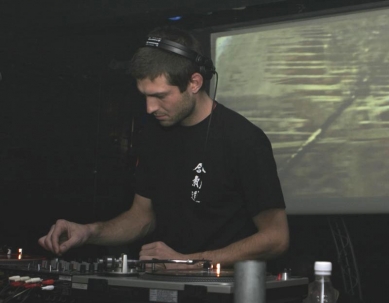
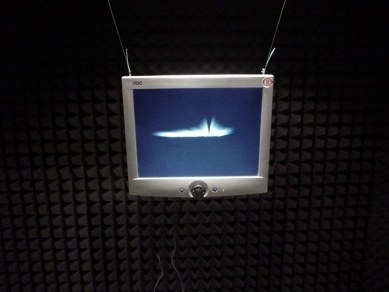
10 DJs were invited to collaborate, who, besides the musical tracks accompanying the whole installation, also created a video clip for each project. All video clips can be found on a DVD that was released as part of this project. The curator of the musical section was Babe LN (Radio1). She is a multimedia graduate from AVU in Prague and is already among the legends of the Czech dance scene.
The DJs were not in direct contact with the authors of the individual architectural designs during their work on this project; they only let their work inspire them.
The graduates themselves heard “their” music only at the opening of the exhibition. They were largely very satisfied with the DJs’ work as well as with the entire installation.
And how do the DJs perceive the Disconnected. Connected! project and what is their relationship to architecture?
MKS
The beginnings of his involvement in the dnb scene date back to late 2001, associated with the North Bohemian crew Agent Orange. He is currently a member of the drumandbass.cz crew, and besides DJing, he is also engaged in promoting and creating his own work, which becomes an integral part of his sets.
How do you retrospectively evaluate the Disconnected. Connected! project? How did it impress you when you heard about it, and how do you perceive it now that the exhibition has opened?
I think the whole project was a very good idea that was just waiting to happen.
It surprised me quite strangely, as I agreed to it without really knowing what it would be about and how it would be handled. And thanks to the successful exhibition, I think it is no longer DISCONNECTED-CONNECTED but RCONNECTED.
How did the architectural design that inspired your work impress you?
The project I chose I had followed in the media when it was discussed, and there was even consideration of its realization. It seemed to me very necessary (in my case, it was the train station terminal project in Hradec Králové).
Are you long interested in architecture, or was this your first closer contact?
It was not my first contact... but I wouldn't say that I dealt with architecture directly. But I am clear on that. I know what I like and what I don't like.
When you visit various objects (stores, offices, means of transport...), do you perceive their soundscapes (whether it is music or just sounds or noise)?
I perceive everything happening around me. I often even do not listen to any music and absorb the surrounding sounds.
Nika 77
She has been DJing since 1997. She has performed in most of the most famous clubs in the Czech Republic and Slovakia, and has played in England, Hungary, Germany, Sweden, Russia, Poland, Belgium, Croatia, Serbia, and Bosnia. In Prague, she is a resident of the Connect Yourself event (Radost FX, Roxy), organized by the largest Czech dance music server in the Czech Republic, www.techno.cz, under whose banner she performs. Her music is primarily techno, though she occasionally plays minimal/deep house and experimental to ambient electronic music. Currently, she is focused on studio work. So far, she has released several items on the Czech label TechEx (002 and 003), Fylo, Ambsine (Vol.1). She is currently working on her own label.
www.nika77.com
How do you retrospectively evaluate the Disconnected. Connected! project? How did it impress you when you heard about it, and how do you perceive it now that the exhibition has opened?
I learned about the project from a colleague in the music industry, BabeLn, who is the curator of the project. She asked me if I would be interested in collaborating, and I agreed, as the whole concept struck me as appealing. I enjoy connecting various artistic directions, and I took it as a challenge.
Unfortunately, I have not yet been to the exhibition, but I plan to visit it in the upcoming days.
How did the architectural design that inspired your work impress you?
The project I chose was the closest to me, which is why I selected it. When I imagined what music I would mix for each project, the theme of refugees resonated with me the most, because both the life of refugees and my music is very adventurous with many diverse influences and elements, changing quickly.
Are you long interested in architecture, or was this your first closer contact?
I am only very marginally interested in it, practically not at all.
When you visit various objects (stores, offices, means of transport...), do you perceive their soundscapes (whether it is music or just sounds or noise)?
I perceive sounds everywhere around me. Sometimes there are moments when one does not have the time to focus on them, especially in today’s fast-paced environment, and sometimes there are moments when I walk through the city and just listen.
Silent Cut
He has been involved in music since 1996 when he acquired his first music software. After some highly abstract projects dave6 and ninsei, where he experimented with sounds from computer games, he moves in the spectrum from downtempo to breakbeat with occasional deviations to dnb. In the club Rotes Berlin, he is trying to establish the tradition of Wednesday FLOWMASTER sessions, where he appears alongside master Emsy (BowWave). Alongside music came an interest in design, from first amateur tape covers to posters for various events, websites, flash animations, photomontages, and t-shirt designs.
How do you retrospectively evaluate the Disconnected. Connected! project? How did it impress you when you heard about it, and how do you perceive it now that the exhibition has opened?
I consider the Disconnected/Connected project to be a clear proof that communication makes sense not only across genres but also between various fields. The idea and the overall essence of the event then solidified this conviction in me, for which I would like to thank everyone, because at the beginning, I could hardly think of meaningful connectivity...
How did the architectural design that inspired your work impress you?
The station represents dynamics for me, but also a place where one waits a lot. Probably this is why I was drawn to this project by Petr Štefek. Another aspect was the very processing of the project. Achieving goals in the area bridging architecture with logistics, social aspects, and who knows what else... It takes courage, and given that, according to my information, developers are already actively interested in its realization, we might see one nice and functional terminal...
Are you long interested in architecture, or was this your first closer contact?
My interest in architecture, after collaborating on o/s, can be described as the most superficial of superficial... but there is something... a few interiors... but fascination has been here for a while... from watching a documentary about Le Corbusier...
When you visit various objects (stores, offices, means of transport...), do you perceive their soundscapes (whether it is music or just sounds or noise)?
When it comes to music, at one point I actively avoided places where radio played. Then I gave that up, but recently, on a business trip, I had the chance to visit a spa hotel where they played those subliminal classics performed by an artificial orchestra and pan flute. That night, I had really ugly dreams. Regarding noise, I would find it hard to generalize... At my parents' house in the mountains, even the fridge distracts me, in the city, I am not bothered by fridges at all...
PS. Besides the musical accompaniment of the presentation, I had the opportunity to work on the visual side of the topic placed on the DVD catalog. I would like to apologize for the resulting appearance of this visualization. Already at the moment when I sent the presentation, it looked like a poor relative compared to other presentations, and after finalization, further unplanned changes led to the result being what it is. If you thought it was some postmodern intention, please stay with that, and if you were disappointed, I apologize again.
Stanzim
He owes his life closely connected with music primarily to Radio 1, where he has worked since its founding in 1991. Through industrial electronic music and Manchester's guitar scene, he came to dance music. He prefers tracks with intricate rhythms of various tempos – from jungle to breakbeat to downtempo. In Prague, he regularly performs at clubs Roxy, Cross, Matrix, Akropolis, Punto Azul, XT3, 7 vlků; outside of Prague in Ostrava, Plzeň, Český Krumlov, Brno, Olomouc, Kladno, Vrchlabí, etc. He participates in festivals such as Creamfields, Open Airfield, Colours Of Ostrava, Cosmic Trip, Sázavafest, Czech-tech, and others, and plays abroad in Vienna, Paris, Bratislava, Nové Zámky, Košice. In 1998, he co-founded the music label QDR with Jan Kvasnička, specializing primarily in listening author albums (Floex, Juanita Juarez, Alvik, Bratři Orffové). They also produced remix compilations for Universal (Ivan Král) and New Gate (Priessnitz). QDR also includes two sublabels: Stoika (dnb) and TT22 (breaks). For the stylistic show Paskvil on ČT2, he prepared reports and co-authored Radiopaskvil, which airs once a month as part of Čajovna on ČRo3.
Nitrous
He has been playing since 1998 in Czech, Polish, Hungarian, Austrian, and Slovak clubs. He is an editor of the Czech music server www.shadowbox.cz. He is the creator of the shadowbox show on Radio 1. In 2000 he became the winner of the Djs awards.
Yukimura
One of the most versatile Czech DJs, with an incredibly broad range far exceeding contemporary electronic and acoustic dance music, he also works as a producer and sound engineer in his studio in Žižkov, from which numerous remixes or vinyl have already emerged. Last year he founded the Kaliyuga Sound association, dedicated to the reproduction and promotion of Asian and oriental music fused with electronics, also known as Asian underground.
Akira
He operates primarily in Karlovy Vary and is a frequent guest at music nights in the Czech Republic and abroad. He is a turntablist, an editor of www.shadowbox.cz, and a member of the dubwize project.
Blue
Blue started DJing in 1996. Thanks to the D-Smack-U agency, he became a resident at Prague's Roxy. He performs in clubs and at various festivals in the Czech Republic, Slovakia, Poland, Austria, the Netherlands, and England. Since 1999, he has regularly organized his resident night aimed at covering progressive directions of the dance scene with guests and new talents. He has been engaged in his own work since 2000. First, in the remix project Blue & Clad (Ecstasy Of St. Theresa, Tatabojs, Here, Priessnitz), then in a purely stage freestyle project Lazy Jimmy with Jan P. Muchow. He is now working solo on his own tracks and remixes. He is involved in stage music, musical, and sound collaborations on theatrical projects (Divadlo Komedie, Bohnická Divadelní Společnost, Divadelní Společnost NUN, Národní Divadlo, Činoherní Studio Ústí nad Labem, Spolek DAMARU, Divadelní Spolek Davida Drábka, DAMU 2006)
Brooklyn aka Juanita Juarez
Under the alias Juanita Juarez, this Prague producer gained attention primarily with the album Spa Boy, released in 2003 on the Quazi Delict label. The album, a combination of drum & bass, downtempo, and more experimental music, was nominated for the Academy of Popular Music Award; followed by official remixes for Escstasy of St. Theresa, Skyline, Slovak Veneer, and most recently for Prague's Khoiba. He currently focuses on a more club-oriented approach to drum & bass. As Juanita Juarez, he has released two twelve-inches on domestic labels. As Brooklyn, he has already released a single on the British label Spearhead, with the track With All My Heart set to be released in March 2006 on the Norwegian label Subtitles, followed by more from several British indie labels. Brooklyn's music has received DJ support from Pendulum and Fresh (Breakbeat Kaos), Nu:Tone (Hospital), Brian G, LTJ Bukem (Good Looking Records), Calyx, Mathematics, Big Buda, and others. Brooklyn alias Juanita Juarez has created several jingles for Radio 1, and his tracks have appeared in theatrical performances, on numerous compilations and recently in the new Czech-Finnish film Restart.
The exhibition runs from March 16 to April 9, 2006.
As mentioned in the introduction, CCEA offers a truly interesting experience this time. This is undoubtedly due to the fact that in collaborating on the installation of the best projects by former students, not only quality DJs were invited, but also top experts in the field of sound installations. The entire exhibit is an interesting experience that reminds us of another, fascinating perspective on architecture.
The project also included a supporting program:
DJs, VJs, and Architecture March 10, 2006 (Cross Club)
Past-Present-Future March 16, 2006 (CCEA)
Start Architecture March 22, 2006 (NoD/Roxy)
Professional Collaboration:
Loan of exhibition containers: Kovobel, production cooperative
Provision of sound-absorbing material: Sinfo s.r.o.
Sound reinforcement of the exhibition: AV Media, a.s.
Lighting of the exhibition: EUROLUX lighting s.r.o.
Consultant for sound installation: Soundsquare Technology s.r.o.
Recordings of comments by architects: Recording studio ELA Prague - music composer Vítězslav Maštalíř
Photography:
© Zoran Kovačević, Martina Svobodová, Jan Vyškovský
This year's third edition (the first took place in 2004 and was subtitled Architecture and Animation, the second in 2005 with the subtitle Architecture and Advertising Photography) has successfully fulfilled this statement by the creators of the installation. Within the limited spaces of CCEA, they managed to place a truly interesting installation that clearly speaks to each visitor.
In the gallery, there are 6 silver shipping containers from which the sounds of the installation faintly reach your ears. If you open the doors of one of the boxes, you find yourself in a small sanctuary. The walls, lined with black acoustic panels, perfectly separate you from the outside world. In the center of the box stands an impressively illuminated model, and you can peacefully listen to the music flowing from the speakers and let your imagination drift as you visualize walking through the real form of the exhibited architecture.
6 quality projects in 6 small private sanctuaries. It is almost surprising how strongly music can influence our perception of the world. Architects, according to one of the participating graduates (Viktor Vlach), generally do not deal with its impact in the designed object. We are not only talking about music itself, but we can discuss all acoustic influences that can occur during the use of the building.
The project works with diploma projects of architecture students, and for the first time this year, graduates were contacted through a call (in previous years, students were selected from exhibitions of individual schools), to which 25 former students responded. Among their works, 6 projects were selected, with emphasis primarily on their philosophy. Preference was given to projects that sought to find answers to certain questions; the question of their actual realization was less important.
The following projects were selected:
Pilgrimage Church in the Doupov Mountains
Jakub Tejkl (AAAD, Prague)The oval perimeter wall of the temple visually resembles a ship settled in the landscape. The horizontal placed in the landscape is complemented by the vertical of the tower. The central structure combines two archetypes of sacred architecture: a bell tower and a chapel. The nave of the temple is not roofed. It consists of perimeter walls woven from fine steel rods and the blue sky.
The stones are brought to the network by the pilgrims themselves, gradually building the church's own walls. It is a manifestation of a sort of act of forgiveness.
CCEA Comment
The church itself does not address the conservation of nature but the salvation of man in nature. We like to choose projects that have a strong idea at first glance, regardless of the realizability or non-realizability of the work.
At a time when architecture is under pressure from investors and often nonsensical regulations from authorities, when architecture distances itself from art, this project shows a way where the pilgrim becomes a builder, playing a role that is written into one of the fundamental instincts of man: “building.”
We selected this project not only because of its original idea, which transforms the spiritual level into action, but also due to its high level of presentation. In the presentation, the author does not mention details and technical specifics, which brings freshness to the whole project and does not tire with unnecessary technicality.
Jakub Tejkl (AAAD Prague)
The author stated that people began to spontaneously offer support for his project; he was surprised by the interest the project generated. Thus, this fall, his book dedicated to this topic should be published as part of the publication activities of the school (AAAD Prague).
Jakub Tejkl currently works in the studio of Bára Škorpilová, mainly on hotel projects around the world.
Settlement for Refugees at Nová Hospoda
Radoslav Dvořák (CTU FA, Prague)The urbanistic-architectural project aimed to create a settlement for 150 refugees and staff. The solution had to meet ecological and economic requirements but should primarily present a functioning integration system in the host country, providing not only accommodation but also opportunities for daily activities, work, education, and rest. The settlement should operate independently and be self-sufficient, especially in ecological terms.
This project strives primarily to bring to light the questions that the issue of refugees raises among us. The entire proposal was subsequently presented to the state administration thanks to the initiative of people who engage with this issue at a professional level, but it received negative feedback from the editor-in-chief of the magazine ERA 21, Osamu Okamura, who was invited as an expert advisor. He pointed to the tendency for the ghettoization of refugees, and as a result, the entire project was dismissed.
CCEA Comment
The diploma thesis opens one of today’s acute problems. For three reasons, it evokes strong optimism in us: the thoroughness with which the pre-diploma seminar was processed, the depth of the topic, and the author’s ability to “survive” five years of schooling, in which students of ZAN-* are attacked by standards, toilet dimensions, simple shapes, clean and logical architecture that has a “strong” idea, and truthful use of materials.
He “survived” since it seems that the proposed design meets all norms and technical parameters, yet at the same time is architecturally different from what is taught at CTU.
The decision to select Radoslav Dvořák’s work was determined by the author’s determination to name the taboo properly based on the analysis into which he invested considerable energy. An aesthetic based on a cultural mix, transformed into a primal dwelling, may not excite us, but the “strong” idea is the foundation of the project.
*ZAN - Fundamentals of Architectural Design - studio work of the first year at CTU, where students very often “design” buildings without anyone questioning the meaning of buildings, construction, and architecture.
Radoslav Dvořák (CTU FA, Prague)
He currently lives in a small village in the Slovak Rudohorie, where, according to him, he enjoys freedom, engaging not only in regular activities like carrying and chopping wood but also in sculpture and furniture making, and occasionally earns a living through graphics.
Reclamation of the North Bohemian Coal Basin
Věra Šatochinová (CTU FA, Prague)The Podkrušnohorská basin, covering 20 x 70 km, extends between Kadaň and Ústí nad Labem. Various specialists should participate in the landscape revitalization project. Ecologists, natural scientists, foresters, sociologists, and architects should also play a significant role. The diploma thesis addresses one part of the project: the architectural aspect, also attempting to delve into issues of ecology.
The author seeks to find an alternative to established solutions, which could be more advantageous from both ecological and economic perspectives. Her original approach to solving the issue will be offered to current landowners despite the realization opportunity being hindered by existing contracts with private firms that are supposed to carry out the reclamation of the given area in a predetermined manner within 40 years.
CCEA Comment
Věra Šatochinová’s proposal is the opposite of the currently established procedure, where the reclamation of landscape damaged by extraction is dealt with by camouflaging what we have done. By creating a maximally energy-independent system to revitalize the devastated area, the scars are transformed into advantages. The inclusion of this project in the selection was influenced not only by the appreciation of the overall solution to the problem but also by the assumption that the attitude of large planners will change over time, and that in 2038 we will consider similar projects as a matter of course.
Věra Šatochinová (CTU FA, Prague)
She currently works in the atelier Z-architects and thus closely collaborates with Igor Kovačevič and Ivette Vašourková, the initiators and main driving forces behind CCEA.
New Center of the Slavonín-North Site in Olomouc
Lukáš Fišer (VUT FA, Brno)Urbanistic design of a new center for the Slavonín-North site in Olomouc. The project addresses the solution for a park, town hall, city houses, and commercial zone.
CCEA Comment
An interesting example of how even in megastructures, which are mostly public investments, a respected real program and the real needs of the area can combine while maintaining sufficient space for leisure and its inhabitants. The architecture of individual objects is clear, and the function is identifiable even from the exterior. We decided to select this project because the confrontation between raster development and organic layouts does not seem like a cliché, but rather a functional coexistence.
Lukáš Fišer (VUT FA, Brno)
He currently works in the 3D HOUSE studio in Stockholm. For this reason, he was not present at the exhibition opening.
Ideal Náchod
Viktor Vlach (AVU, Prague)The theme of the diploma thesis is the ideal plan for the author's hometown, in this specific case, Náchod. A city that the author has known for a quarter of a century, aware of its mistakes and shortcomings. The city is perceived as a living organism. The goal of new urbanism is to make Náchod a healthy individual, a manly city, or at least guide successors to think, which will eventually heal the organism.
The most striking element of the entire proposal, a kind of manifesto, is the placement of the “log” of the new series of shops in the center of the village, which naturally creates a lively bridge between the center of Náchod and nearby neighborhoods. Attention is particularly drawn to the shape, atypical for this type of building.
Given that the representatives of the city of Náchod did not provide any support to the author during the preparation of the project solution nor in locating the materials, the author does not intend to familiarize them with the results of his work.
CCEA Comment
The author has developed a series of solutions that change the character of the city. Simple forms of cylinders and prismatic shapes are transformed into buildings that enrich the city with functions it has so far lacked.
The author’s confidence in working with the simplest archetypes may face considerable difficulties in confronting the reality of authorities, investors, municipalities, the public, and the current poor urbanism. However, it establishes a platform for discussion. We included this project in the selection as a manifesto of contemporary Czech urbanism.
Viktor Vlach (AVU Prague)
He currently works in the Karlín studio "třiarchitekti." He, together with Vladimír Vašut, founded the informal association "under-construction architects."
Terminal Hradec Králové
Petr Štefek (TU Liberec)The Hradec railway station designed by Václav Rejchl was one of the most generous transport buildings upon its completion. However, today, railway transport has lost its privileged position. Current designs do not reflect this fact and extensively occupy further areas of the city's territory for poorly located bus stations. The aim of the diploma thesis is a proposal for a compact terminal for all types of truly integrated transport, aiming to enhance the significance of the cultural monument.
With his design, the author aimed to reflect experiences with bus terminals across Europe he had the opportunity to familiarize himself with. He tries to find an alternative to the continuously repeated solutions in our country, which strictly correspond to the relevant norms.
CCEA Comment
An interesting approach in which the needs of the public as voters and the public as consumers intertwine. The intertwining of public and commercial functions is a necessity whose solution we cannot avoid in the future. Petr Štefek’s project transforms this challenge into interesting contemporary architecture, situated in the “underground,” where the mix of functions serves as an intriguing social experiment. Besides the architectural expression, the timeliness of the problem also contributed to the selection.
Petr Štefek (TU Liberec)
He currently works in Norman Foster’s London studio, which has around 400 employees along with another 250 staff across offices worldwide. He perceives this experience as further deepening his studies.
10 DJs were invited to collaborate, who, besides the musical tracks accompanying the whole installation, also created a video clip for each project. All video clips can be found on a DVD that was released as part of this project. The curator of the musical section was Babe LN (Radio1). She is a multimedia graduate from AVU in Prague and is already among the legends of the Czech dance scene.
The DJs were not in direct contact with the authors of the individual architectural designs during their work on this project; they only let their work inspire them.
The graduates themselves heard “their” music only at the opening of the exhibition. They were largely very satisfied with the DJs’ work as well as with the entire installation.
And how do the DJs perceive the Disconnected. Connected! project and what is their relationship to architecture?
MKS
The beginnings of his involvement in the dnb scene date back to late 2001, associated with the North Bohemian crew Agent Orange. He is currently a member of the drumandbass.cz crew, and besides DJing, he is also engaged in promoting and creating his own work, which becomes an integral part of his sets.
How do you retrospectively evaluate the Disconnected. Connected! project? How did it impress you when you heard about it, and how do you perceive it now that the exhibition has opened?
I think the whole project was a very good idea that was just waiting to happen.
It surprised me quite strangely, as I agreed to it without really knowing what it would be about and how it would be handled. And thanks to the successful exhibition, I think it is no longer DISCONNECTED-CONNECTED but RCONNECTED.
How did the architectural design that inspired your work impress you?
The project I chose I had followed in the media when it was discussed, and there was even consideration of its realization. It seemed to me very necessary (in my case, it was the train station terminal project in Hradec Králové).
Are you long interested in architecture, or was this your first closer contact?
It was not my first contact... but I wouldn't say that I dealt with architecture directly. But I am clear on that. I know what I like and what I don't like.
When you visit various objects (stores, offices, means of transport...), do you perceive their soundscapes (whether it is music or just sounds or noise)?
I perceive everything happening around me. I often even do not listen to any music and absorb the surrounding sounds.
Nika 77
She has been DJing since 1997. She has performed in most of the most famous clubs in the Czech Republic and Slovakia, and has played in England, Hungary, Germany, Sweden, Russia, Poland, Belgium, Croatia, Serbia, and Bosnia. In Prague, she is a resident of the Connect Yourself event (Radost FX, Roxy), organized by the largest Czech dance music server in the Czech Republic, www.techno.cz, under whose banner she performs. Her music is primarily techno, though she occasionally plays minimal/deep house and experimental to ambient electronic music. Currently, she is focused on studio work. So far, she has released several items on the Czech label TechEx (002 and 003), Fylo, Ambsine (Vol.1). She is currently working on her own label.
www.nika77.com
How do you retrospectively evaluate the Disconnected. Connected! project? How did it impress you when you heard about it, and how do you perceive it now that the exhibition has opened?
I learned about the project from a colleague in the music industry, BabeLn, who is the curator of the project. She asked me if I would be interested in collaborating, and I agreed, as the whole concept struck me as appealing. I enjoy connecting various artistic directions, and I took it as a challenge.
Unfortunately, I have not yet been to the exhibition, but I plan to visit it in the upcoming days.
How did the architectural design that inspired your work impress you?
The project I chose was the closest to me, which is why I selected it. When I imagined what music I would mix for each project, the theme of refugees resonated with me the most, because both the life of refugees and my music is very adventurous with many diverse influences and elements, changing quickly.
Are you long interested in architecture, or was this your first closer contact?
I am only very marginally interested in it, practically not at all.
When you visit various objects (stores, offices, means of transport...), do you perceive their soundscapes (whether it is music or just sounds or noise)?
I perceive sounds everywhere around me. Sometimes there are moments when one does not have the time to focus on them, especially in today’s fast-paced environment, and sometimes there are moments when I walk through the city and just listen.
Silent Cut
He has been involved in music since 1996 when he acquired his first music software. After some highly abstract projects dave6 and ninsei, where he experimented with sounds from computer games, he moves in the spectrum from downtempo to breakbeat with occasional deviations to dnb. In the club Rotes Berlin, he is trying to establish the tradition of Wednesday FLOWMASTER sessions, where he appears alongside master Emsy (BowWave). Alongside music came an interest in design, from first amateur tape covers to posters for various events, websites, flash animations, photomontages, and t-shirt designs.
How do you retrospectively evaluate the Disconnected. Connected! project? How did it impress you when you heard about it, and how do you perceive it now that the exhibition has opened?
I consider the Disconnected/Connected project to be a clear proof that communication makes sense not only across genres but also between various fields. The idea and the overall essence of the event then solidified this conviction in me, for which I would like to thank everyone, because at the beginning, I could hardly think of meaningful connectivity...
How did the architectural design that inspired your work impress you?
The station represents dynamics for me, but also a place where one waits a lot. Probably this is why I was drawn to this project by Petr Štefek. Another aspect was the very processing of the project. Achieving goals in the area bridging architecture with logistics, social aspects, and who knows what else... It takes courage, and given that, according to my information, developers are already actively interested in its realization, we might see one nice and functional terminal...
Are you long interested in architecture, or was this your first closer contact?
My interest in architecture, after collaborating on o/s, can be described as the most superficial of superficial... but there is something... a few interiors... but fascination has been here for a while... from watching a documentary about Le Corbusier...
When you visit various objects (stores, offices, means of transport...), do you perceive their soundscapes (whether it is music or just sounds or noise)?
When it comes to music, at one point I actively avoided places where radio played. Then I gave that up, but recently, on a business trip, I had the chance to visit a spa hotel where they played those subliminal classics performed by an artificial orchestra and pan flute. That night, I had really ugly dreams. Regarding noise, I would find it hard to generalize... At my parents' house in the mountains, even the fridge distracts me, in the city, I am not bothered by fridges at all...
PS. Besides the musical accompaniment of the presentation, I had the opportunity to work on the visual side of the topic placed on the DVD catalog. I would like to apologize for the resulting appearance of this visualization. Already at the moment when I sent the presentation, it looked like a poor relative compared to other presentations, and after finalization, further unplanned changes led to the result being what it is. If you thought it was some postmodern intention, please stay with that, and if you were disappointed, I apologize again.
Other Participating DJs:
Stanzim
He owes his life closely connected with music primarily to Radio 1, where he has worked since its founding in 1991. Through industrial electronic music and Manchester's guitar scene, he came to dance music. He prefers tracks with intricate rhythms of various tempos – from jungle to breakbeat to downtempo. In Prague, he regularly performs at clubs Roxy, Cross, Matrix, Akropolis, Punto Azul, XT3, 7 vlků; outside of Prague in Ostrava, Plzeň, Český Krumlov, Brno, Olomouc, Kladno, Vrchlabí, etc. He participates in festivals such as Creamfields, Open Airfield, Colours Of Ostrava, Cosmic Trip, Sázavafest, Czech-tech, and others, and plays abroad in Vienna, Paris, Bratislava, Nové Zámky, Košice. In 1998, he co-founded the music label QDR with Jan Kvasnička, specializing primarily in listening author albums (Floex, Juanita Juarez, Alvik, Bratři Orffové). They also produced remix compilations for Universal (Ivan Král) and New Gate (Priessnitz). QDR also includes two sublabels: Stoika (dnb) and TT22 (breaks). For the stylistic show Paskvil on ČT2, he prepared reports and co-authored Radiopaskvil, which airs once a month as part of Čajovna on ČRo3.
Nitrous
He has been playing since 1998 in Czech, Polish, Hungarian, Austrian, and Slovak clubs. He is an editor of the Czech music server www.shadowbox.cz. He is the creator of the shadowbox show on Radio 1. In 2000 he became the winner of the Djs awards.
Yukimura
One of the most versatile Czech DJs, with an incredibly broad range far exceeding contemporary electronic and acoustic dance music, he also works as a producer and sound engineer in his studio in Žižkov, from which numerous remixes or vinyl have already emerged. Last year he founded the Kaliyuga Sound association, dedicated to the reproduction and promotion of Asian and oriental music fused with electronics, also known as Asian underground.
Akira
He operates primarily in Karlovy Vary and is a frequent guest at music nights in the Czech Republic and abroad. He is a turntablist, an editor of www.shadowbox.cz, and a member of the dubwize project.
Blue
Blue started DJing in 1996. Thanks to the D-Smack-U agency, he became a resident at Prague's Roxy. He performs in clubs and at various festivals in the Czech Republic, Slovakia, Poland, Austria, the Netherlands, and England. Since 1999, he has regularly organized his resident night aimed at covering progressive directions of the dance scene with guests and new talents. He has been engaged in his own work since 2000. First, in the remix project Blue & Clad (Ecstasy Of St. Theresa, Tatabojs, Here, Priessnitz), then in a purely stage freestyle project Lazy Jimmy with Jan P. Muchow. He is now working solo on his own tracks and remixes. He is involved in stage music, musical, and sound collaborations on theatrical projects (Divadlo Komedie, Bohnická Divadelní Společnost, Divadelní Společnost NUN, Národní Divadlo, Činoherní Studio Ústí nad Labem, Spolek DAMARU, Divadelní Spolek Davida Drábka, DAMU 2006)
Brooklyn aka Juanita Juarez
Under the alias Juanita Juarez, this Prague producer gained attention primarily with the album Spa Boy, released in 2003 on the Quazi Delict label. The album, a combination of drum & bass, downtempo, and more experimental music, was nominated for the Academy of Popular Music Award; followed by official remixes for Escstasy of St. Theresa, Skyline, Slovak Veneer, and most recently for Prague's Khoiba. He currently focuses on a more club-oriented approach to drum & bass. As Juanita Juarez, he has released two twelve-inches on domestic labels. As Brooklyn, he has already released a single on the British label Spearhead, with the track With All My Heart set to be released in March 2006 on the Norwegian label Subtitles, followed by more from several British indie labels. Brooklyn's music has received DJ support from Pendulum and Fresh (Breakbeat Kaos), Nu:Tone (Hospital), Brian G, LTJ Bukem (Good Looking Records), Calyx, Mathematics, Big Buda, and others. Brooklyn alias Juanita Juarez has created several jingles for Radio 1, and his tracks have appeared in theatrical performances, on numerous compilations and recently in the new Czech-Finnish film Restart.
The exhibition runs from March 16 to April 9, 2006.
As mentioned in the introduction, CCEA offers a truly interesting experience this time. This is undoubtedly due to the fact that in collaborating on the installation of the best projects by former students, not only quality DJs were invited, but also top experts in the field of sound installations. The entire exhibit is an interesting experience that reminds us of another, fascinating perspective on architecture.
The project also included a supporting program:
DJs, VJs, and Architecture March 10, 2006 (Cross Club)
Past-Present-Future March 16, 2006 (CCEA)
Start Architecture March 22, 2006 (NoD/Roxy)
Professional Collaboration:
Loan of exhibition containers: Kovobel, production cooperative
Provision of sound-absorbing material: Sinfo s.r.o.
Sound reinforcement of the exhibition: AV Media, a.s.
Lighting of the exhibition: EUROLUX lighting s.r.o.
Consultant for sound installation: Soundsquare Technology s.r.o.
Recordings of comments by architects: Recording studio ELA Prague - music composer Vítězslav Maštalíř
Photography:
© Zoran Kovačević, Martina Svobodová, Jan Vyškovský
The English translation is powered by AI tool. Switch to Czech to view the original text source.


6 comments
add comment
Subject
Author
Date
...
Viktor Vlach
29.03.06 06:10
re:...
Petr Šmídek
29.03.06 08:42
...
Viktor Vlach
30.03.06 09:56
re:...
Martina
03.04.06 08:44
...
Viktor Vlach
04.04.06 09:18
show all comments