
French designer Patrick Blanc dresses buildings in greenery
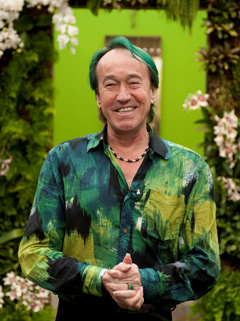 |
"I wanted to work on parking lots. I achieved that. I wanted to work on bridges. I dreamed of very tall buildings, and lo and behold, I ended up in Sydney," says Blanc. It was indeed in Sydney that he greened a building 150 meters tall. "My only dream is to bring nature where no one would expect it," he adds.
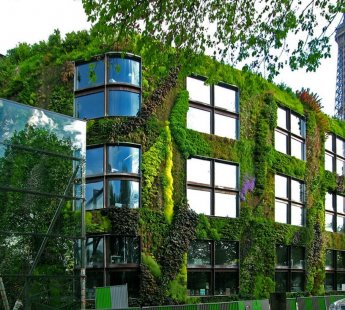
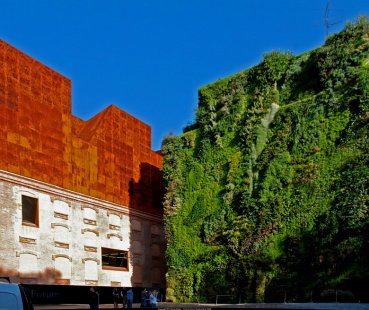
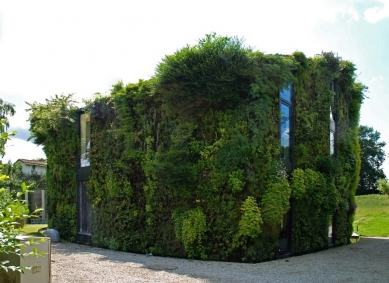
His vertical gardens in the heart of stone and concrete cities have now become part of their appearance. They are on the walls of museums, like the Quai Branly in Paris, hotels, luxury residences, but also shopping centers, such as Clayes-Sous-Bois in the Paris region. "It's 250 meters long and eight meters high. A green embrace. Undoubtedly a record when it comes to area," Blanc proudly declares, exuding youthful energy despite his sixty years.
His latest creation, recently presented in the center of Paris, is humbler: an originally ugly wall on Aboukir Street in the 2nd arrondissement, now referred to as an oasis, boasts nearly 250 plants reminiscent of savannas or Mediterranean scrub. Blanc invented a soil-less plant-growing system when he was young, cleaning an aquarium with the help of a philodendron that began to climb up the wall.
Peat, coconut fibers, wire mesh. Many experiments followed to find the best medium allowing plants to grow vertically. He eventually discovered a suitable method: a layer of felt attached to a PVC base that serves as support for the roots. According to AFP, all of this is secured to a metal frame that can be attached to a wall or stand alone.
He patented his technique in 1988 and presented it at the garden festival in Chaumont-sur-Loire in central France in 1994. "It was a great success; I didn't expect it at all," he says. Since then, he has not stopped.
His walls, of course, have other advantages, such as contributing to the environment, thermal insulation, and cooling in summer. "People are fascinated by it mainly because it resembles the habitats of prehistoric cave dwellers. Plants thrived around those caves. It’s a memory that’s 30,000 years old," says Blanc.
Over the years, the palette of plants he uses for his green walls has continually expanded. "I constantly travel, and every time I find plants I haven’t used yet and didn’t think would be suitable," he emphasizes.
In his latest Parisian creation, he "planted" twenty new species. However, he says he will like his wall much more in about three years. "When there will be openings in the dense green carpet, when the plants differentiate, and some die. Simply when the wall is more alive. In a natural environment, plants also do not cover everything," he says.
Blanc is already preparing another project - the world's first botanical garden of vines. A hundred species will climb up a 200-meter tall building in Kuala Lumpur. He is also considering a huge green spiral in a shopping center in Bangkok. "Every wall is a new experience for me," he adds.
The English translation is powered by AI tool. Switch to Czech to view the original text source.

0 comments
add comment