Exhibition of Farm Gates in the Mladá Boleslav Region
Publisher Tisková zpráva
30.08.2013 08:30
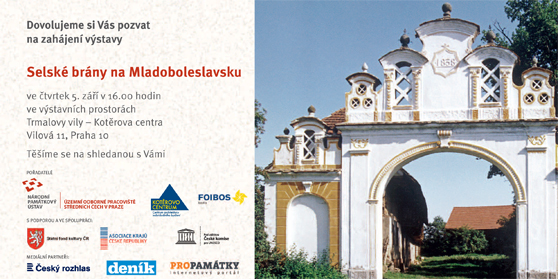
On Thursday, September 5, 2013, at 4:00 PM, there will be an opening of the reprised exhibition “Farm Gates in the Mladá Boleslav Region” in the exhibition halls of Trmal Villa – Kotěra Center (Vilová 11, Prague 10). The author of the exhibition, which has previously been on display at the Museum of Folk Architecture in Kouřim, is Mgr. Jana Berková, head of the specialists department of the National Heritage Institute – Regional Office for Central Bohemia (referred to as NPÚ ÚOP Central Bohemia) and an expert on folk architecture. The mentioned exhibition, which will be open to the public throughout the month of September, is one of several activities in which NPÚ participates in the year-round program of events related to the declaration of 2013 as the Year of Folk Architecture of Bohemia, Moravia, and Silesia.
The exhibition "Farm Gates in Mladá Boleslav Region" is indeed relatively narrowly defined in thematic and geographical terms, but it focuses on a phenomenon that significantly transcends the borders of the region and can be placed on par with the structures of well-known masters of South Bohemian so-called peasant baroque. Monuments of folk architecture, specifically brick farm gates, are represented in a relatively abundant number in Central Bohemia; however, a collection of gates located at the border of Kokořínsko and Mladoboleslavsko—more precisely in the area between the towns of Mšeno and Bělá pod Bezdězem—stands out due to its significance. The origin of these monuments can be placed within a relatively short period defined by the 20s and 40s of the 18th century. This period was pivotal in the development of folk architecture. Starting from the first half of the 19th century, in conjunction with the fertility and economic development of a specific region, brick constructions began to penetrate folk building on a broader scale, which had until then occurred rather exceptionally in village architecture. In some areas, the tradition of timbered constructions was so strong that brick structures first appeared in the form of supplementary buildings—namely, farm gates. The construction of a brick gate was a question of representation for the owner of a farmstead. Due to their higher financial demands, brick gates were initially built at large estates. Only in the following years, with the development of new agricultural practices and the introduction of economically more profitable crops, did the construction of brick gates occur also at smaller farms. The appearance of farm gates in the Mladá Boleslav region reflects the former village community's ideas about tasteful and representative interpretations of the farm's facade. Their appearance was influenced primarily by examples of local Baroque and Classicist buildings and the distinctive use and transformation of stylistic elements and influences. Inspirations were found not only in the realm of secular architecture but also in sacred buildings as a source of inspiration. The intricacy of the silhouette of the farm gates contributes to the picturesque appearance of a number of villages. Characteristic features of farm gates in the studied area primarily include gable extensions, rich stucco decoration, and vibrant colors. Their plastic decoration combines purely folk motifs with elements borrowed from stylistic architecture. The exhibition "Farm Gates in Mladá Boleslav Region" addresses not only the formal appearance of these buildings but also pays attention to the symbolic significance of the decorative elements used. The author of the exhibition, Mgr. Jana Berková, primarily focused on the monuments located in the territories of Borče and Vrátno; however, some examples from the following municipalities are also represented: Víska, Skalsko, Choroušky, and Sedlec in Mělnicko.