
Exhibition Manfred Wolff-Plottegg: Generative Architectures
September 22 - November 30, 2009, Gallery of the Austrian Cultural Forum in Prague
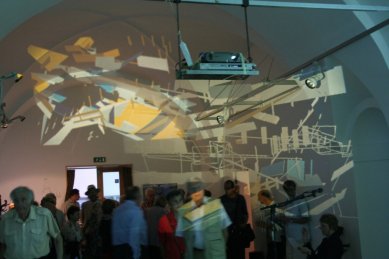
The exhibition at RKF showcases the work of architect Manfred Wolff-Plottegg. Its title "Generative Architectures", meaning architectures in plural that are generated on computers, indicates that the author consistently aims for a new understanding of architecture. In doing so, he corrects old models and creates new systems in their place, which are hybrid, dynamic, and capable of adapting to any conditions. The essence and creative concept is architecture based on algorithms. According to Manfred Wolff-Plottegg, the architect is a designer of algorithms and an interpreter of codes.
Professor Manfred Wolff-Plottegg lectured on generative, algorithmic, and neural architectures several years ago at the Prague Academy of Fine Arts. For the needs of print, we include an excerpt from the program text for the exhibition:
Architecture Generators: Since the early 1980s, progressive development in architectural design has begun to incorporate new essential aspects through the generation of architecture via computer programming. The application of this medium and the overall environment of new scientific theories have brought about an "algorithmic revolution": As a result, it became possible to remove the core activity of the architect, i.e., design, from analog, traditionally content-based considerations and linear functional solutions, and assign it to "systemic design".
A far-reaching and more radical change lies in the use of computers in process management - in the very specifics of the computer, as suggested by the term "CPU" (central processing unit). Therefore, already in the 1960s, changes anticipated by cybernetics could occur: from designing a final state to developmental design, thus shifting from determinism to relativity; from an architectural perspective, from object architecture (the language of forms) to procedural architecture. It's no longer about how a building looks, but what it is capable of and how it can further evolve during the design process. Just as with industrial buildings or hospitals, urban planning is also about how to manage the overall design process. Computer simulations are suitable tools for this, of course involving three-dimensional modeling through parameterized and generative algorithms…
Different areas of reality are present as binary strings of characters, as a vocabulary for communication - between neurons as well as between computers. Information, images, and ideas of the real world and the world in our minds, as encoded by biological organisms and the world of digital data processing, are interconnected by a common factor: information processing. The creation of images, spaces, architectures no longer needs to be carried out manually, intellectually, anthropocentrically, expressively; everything can be practiced as data processing, data manipulation. The exclusive handling of classical elements such as column/wall/ceiling and their use is being transferred to the software domain.
Manfred Wolff-Plottegg (1946) is a university professor and heads the Institute of Architecture and Planning at the Faculty of Architecture at the Technical University of Vienna (Fakultät für Architektur und Raumplanung, Institut für Architektur und Entwerfen, TU Wien). He is the author of several significant buildings, competition projects, exhibitions, and lectures. Two significant theoretical publications have been published by the Viennese publishing house Passagenverlag: "Architektur Algorithmen" (1996) and "Hybrid Architektur und Hyper Funktionen" (2006).
Professor Manfred Wolff-Plottegg lectured on generative, algorithmic, and neural architectures several years ago at the Prague Academy of Fine Arts. For the needs of print, we include an excerpt from the program text for the exhibition:
Architecture Generators: Since the early 1980s, progressive development in architectural design has begun to incorporate new essential aspects through the generation of architecture via computer programming. The application of this medium and the overall environment of new scientific theories have brought about an "algorithmic revolution": As a result, it became possible to remove the core activity of the architect, i.e., design, from analog, traditionally content-based considerations and linear functional solutions, and assign it to "systemic design".
A far-reaching and more radical change lies in the use of computers in process management - in the very specifics of the computer, as suggested by the term "CPU" (central processing unit). Therefore, already in the 1960s, changes anticipated by cybernetics could occur: from designing a final state to developmental design, thus shifting from determinism to relativity; from an architectural perspective, from object architecture (the language of forms) to procedural architecture. It's no longer about how a building looks, but what it is capable of and how it can further evolve during the design process. Just as with industrial buildings or hospitals, urban planning is also about how to manage the overall design process. Computer simulations are suitable tools for this, of course involving three-dimensional modeling through parameterized and generative algorithms…
Different areas of reality are present as binary strings of characters, as a vocabulary for communication - between neurons as well as between computers. Information, images, and ideas of the real world and the world in our minds, as encoded by biological organisms and the world of digital data processing, are interconnected by a common factor: information processing. The creation of images, spaces, architectures no longer needs to be carried out manually, intellectually, anthropocentrically, expressively; everything can be practiced as data processing, data manipulation. The exclusive handling of classical elements such as column/wall/ceiling and their use is being transferred to the software domain.
Manfred Wolff-Plottegg (1946) is a university professor and heads the Institute of Architecture and Planning at the Faculty of Architecture at the Technical University of Vienna (Fakultät für Architektur und Raumplanung, Institut für Architektur und Entwerfen, TU Wien). He is the author of several significant buildings, competition projects, exhibitions, and lectures. Two significant theoretical publications have been published by the Viennese publishing house Passagenverlag: "Architektur Algorithmen" (1996) and "Hybrid Architektur und Hyper Funktionen" (2006).
The English translation is powered by AI tool. Switch to Czech to view the original text source.


0 comments
add comment