Dominik Aleš - Prague-Bubny

The FA CTU Award 2007/2008, Urbanism Category, 2nd Prize

Publisher
Kateřina Lopatová
13.03.2009 11:30
4th Year FA CTU (studio of Patrik Kotase)

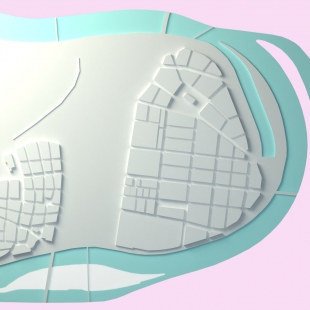
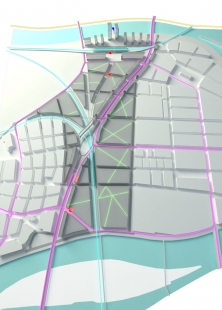
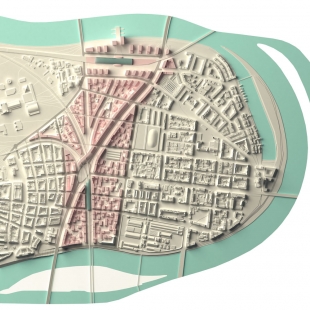
The aim of the design is to create a new district in Prague with a distinct character while organically connecting the surrounding urban areas. The proposal addresses new city streets as a main public space and discusses the urban block and its interior as a cozier variant of the public space.

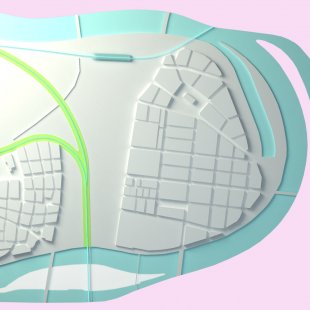
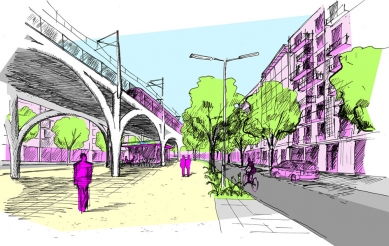
The proposal emphasizes new thoroughfares – a promenade around the railway viaduct coming from Stromovka Park and the urban boulevard Magistrála between Hlávkův Bridge and Barikádníků Bridge.
Large blocks are built with individual houses, among which semi-private gardens, alleys, small squares, and parks emerge.

DEFINITION OF THE ADDRESSED AREA
The addressed area is located in the wider center of Prague. It is an extensive space of the unused railway station Praha-Bubny and a neglected area to the north of the station.
The first part of the addressed area consists of the plot of Bubny station. It is to be dismantled and replaced by a new Prague district. Today, there is an unmanaged site forming an impenetrable barrier between the neighboring urban areas.
The second part is the location between the area of Bubny station and Holešovice station. Here, sparse building of several apartment houses exists with a street network that does not connect to the surroundings.
The third part of the addressed area is the unused waterfront behind Holešovice station.

NEEDS AND POTENTIALS OF THE AREA
The addressed area lies between two established urban structures - the Prague quarters of Holešovice and Letná. Both of these quarters stand out with their distinctive character. They differ from each other, having different origins and subsequent developments. Due to the Bubny railway station, there has never been a connection between them. Both districts end unnaturally and abruptly at the property line of the station.
It is necessary to organically build upon their unfinished structure and connect the quarters.
Adjacent to the addressed area are the neighboring sites of the Exhibition Grounds and the Holešovice heating plant. The heating plant will be dismantled, allowing for the expansion of additional exhibition pavilions on its grounds. This could lead to the creation of a second axis of an extended Exhibition Grounds along the Kralupy railway line, which today separates the existing site from the heating plant. A second entrance oriented towards the addressed area could logically emerge along this axis.
Along the Exhibition Grounds, the Royal Game Reserve stretches to the boundary of the addressed area along the Buštěhrad railway. Besides the Vltava River which borders the area from the south and north, Stromovka Park is another significant natural element in the area.
Among the linear routes entering the addressed area, the railway is the most prominent. While leading on a viaduct, it is easy to avoid the barrier effect and, conversely, it is possible to capture its dynamism and allow the greenery from Stromovka to flow alongside it into the heart of the new development.
Another significant line intersecting the area is the now negatively perceived Prague north-south magistral. However, when reassessing the role of the Magistral as a whole, this communication does not have to be a highway thoroughfare through the city center in the future. When transformed into a celebrated exhibition boulevard in Prague, the Magistral can be highlighted in any profile here. The newly conceived Magistral can thus become one of the main advantages of this area.
A third significant route in the area is the missing connection of the main streets Veletržní and Dělnická, coming from the west and east. These streets, which continue uninterrupted through the adjacent quarters, end at the boundary of the addressed area almost opposite each other. Today's connection between Letná and Palmovka must thus be routed diversely.

DESIGN
The design organically connects to the built structures of the surrounding quarters. It naturally links and closes their structure. At the same time, however, the new structure is very distinctive and characteristically significant. Thus, a new sovereign Prague district distinctly recognizable from the neighboring quarters is created.
The arrangement of the new district does not resemble the composition from the 19th century, yet it espouses the same traditional values of streets and squares.
The design utilizes the potential of the passing railway and the magistral. The greatest energy flows through these lines, and the main part of public life occurs here.
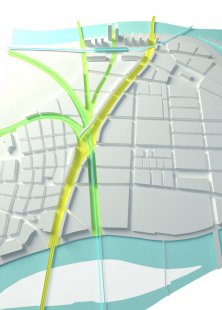
The railway, Magistral, Veletržní Street, and Dělnická Street intersect at a single focal point. This creates the main center of the district in its center. A city railway station is situated here, allowing transfers to the metro and trams.
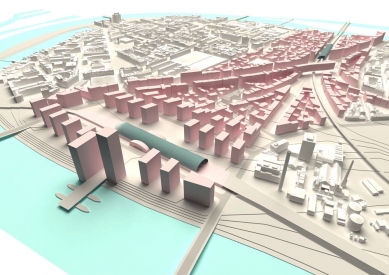
Around Holešovice station, a second center emerges, which is also the massing culmination of the district. High-rise buildings rise along the Vltava river, responding to the opposite bank with a steep slope. This area has a more commercial administrative character and is quieter than the central focus of the district.
There is a second public transport transfer hub here. In addition to the railway station, there is a metro station and tram stops. On the axis running through the station, a new harbor for passenger transportation is established on the river.
The design features large blocks emerging from the sparse grid of Holešovice's street network. This type of development creates a contrast between the outside world of the streets and the inner world of the courtyards. The inner world offers a smaller scale, fragmented building, local small squares, interior streets, and semi-private gardens. There is no automobile traffic here. The buildings are serviced by a system of underground garages accessible from the outer streets. This contrast between the outer and inner world is one of the main principles of the design.
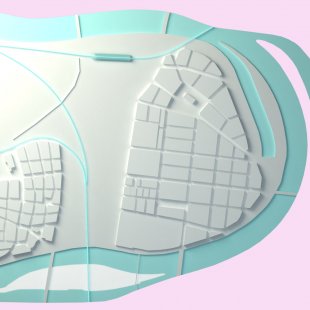
Greenery in the new district is primarily represented by a linear park-street along the railway lines. Two streams of greenery from Stromovka converge in the middle of the district, where the space opens slightly. The green river then flows into the Vltava at the beginning of the Negrelli viaduct, where a new pedestrian bridge running parallel to the viaduct leading towards Vítkov Hill and the city center is proposed. Additional local parks can alternate with small squares within the courtyards.

MAGISTRÁLA
The Magistral is perceived positively in this project, contrary to the usual perception. Today, it is a capacity road thoroughfare through the city from south to north, bringing transit traffic to the very edge of the historic core of Prague. The construction of tunnels and further segregation of the Magistral would only strengthen its status as a highway. However, if we reassess the role of the Magistral, we can transform it into a prestigious main Prague avenue. An avenue that would become a symbol of modern Prague. A vibrant boulevard that the people of Prague would be proud of. In such a case, the location of the Magistral suddenly becomes ideal and historically justified. It runs along the site of demolished Baroque walls around old Prague – just like Vienna’s famous Ringstraße. However, in Prague, our avenue does not circle around the historic core but continues linearly north and south, connecting several urban quarters and gradually transitioning into an expressway until it finally leaves Prague as highway D1 or D8. The Magistral is destined for glory by its route.
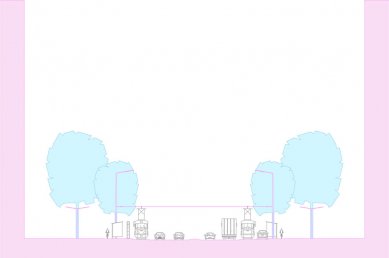
The project anticipates a targeted reduction in traffic capacity of the Magistral following the commissioning of the city ring, which should take over the transit traffic. The Magistral is considered as a communication route with two traffic lanes for cars in each direction, with a lane for trams, a bike path, and longitudinal parking where width conditions allow. The presence of trams, as surface public transport with frequent stops, is crucial. The co-existence with line C of the metro is not conflicting. The street layout is intended as a boulevard-type – hence the trams at the edges of the road by the sidewalks. This configuration involves more complex junction solutions but brings higher user comfort for passengers. The street profile does not provide for a special lane for service traffic – delivery vehicles would be allowed to enter the sidewalk during nighttime hours.
The Magistral undergoes a transformation along its route through Prague. It divides into several sections, each distinct and characteristic. In the area of the addressed zone, the Magistral is currently interrupted – this section is still missing. It is therefore possible to build it in any profile. The character of this segment will rightfully be specific.
The Magistral is not a street of this district. It is a citywide street that has touched this urban part. Its journey begins at Hlávkův Bridge, then crosses the center of the district, finally passing closely by a cluster of tall buildings while continuing its journey into another city district after Barikádníků Bridge.

RAILWAY
The railway has always been one of the main factors influencing the growth of cities. Railway stations acted as magnets for newly emerging blocks. Conversely, the tracks themselves often marked the boundary of continuous buildings. For example, the trajectory of the Buštěhrad railway defined the northern limit of the block development of Letná. Even the development of the proposed district Bubny traces its street lines along the Buštěhrad and Kralupy lines. However, the railway runs on a viaduct, thus it does not act as a barrier. It merely defines the trajectory of the street, just like the Negrelli viaduct in Prvního pluku Street in Karlín.
Both railway lines come from Stromovka. The streets around these lines thus serve as a strong connection to this park. They are designed as promenades – with calmed automobile traffic, a significant representation of greenery, and a wide central sidewalk with a sandy surface. Both streets converge in the central area of the district. From the city railway station Praha-Bubny, only a single viaduct and street continues south. This ends at the banks of the Vltava. The railway continues further on the Negrelli viaduct. Next to the historical viaduct, a parallel pedestrian and cyclist bridge is planned. Just like the railway viaduct, the pathway on the bridge goes across the river, leading towards Vítkov Hill and Masaryk Station. The promenade street around the railway and the new bridge thus connect significant parts of Prague's greenery.
Automobile, bicycle, and pedestrian traffic in the promenade streets operates on the principles of so-called Shared Space. This refers to a solution where a certain transportation space is defined within the street, which is not further divided or controlled. This traffic corridor is at the same level as the surrounding surfaces. There are no pedestrian crossings or bike paths here. All traffic participants move freely. The absence of right-of-way leads to increased caution, reduced vehicle speeds, and mutual respect among traffic participants. The result is that the traffic is safer than on normal streets with segregated operation. www.shared-space.org
Traffic areas of the promenade streets are fully connected to the rest of the district road network. There are no no-through zones. However, given the nature of the traffic in these streets, passage can be lengthy, so transit traffic is naturally regulated here.

INNER BLOCK
In this design, a block is the smallest self-contained urban unit. Each has its unique structure, its center, and its boundaries. There are internal streets, local squares, and gardens of residential houses behind fences. Local residents feel their belonging to the block. In small public spaces, you can see kids training for a Saturday match against those "from behind Dělnická." People enjoy going for dinner after work to the restaurant in their square. Life here is calm, as if the outer world of the streets were just a memory of a challenging day out there, in the city.
The precise structure of the block is not predetermined. Only some limits and general rules are given. Individual houses thus emerge freely while respecting these rules, but they must respond to the houses that were built before them. Each house is thus influenced primarily by the buildings constructed earlier. The structure therefore evolves spontaneously, and the development within the block is "grown."
General rules include the following: The outer street line must be built upon within a given percentage range. The maximum building height is determined by the number of storeys and decreases from the edges to the center of the block. Maximum floor area dimensions and their minimum separations in relation to their height are set. Axes of internal streets are defined in natural directions, with the street line not determined; only the minimum street width is defined – it then arises more as a sequence of interconnected public spaces. In the middle of the block, an area for a square or park is designated.
The construction within the block is lower, denser, and more fragmented than in typical street blocks. The scale is smaller. Staying in such an environment is more pleasant.
Automobiles are excluded from the inner block. Buildings not adjacent to the outer streets are serviced from underground garages, which are interconnected with a designated network. Usually, there are four accesses to the garage system – one on each side of the block. The liberation of the public spaces of the inner block from cars significantly contributes to the calm atmosphere of the inner world.
Thanks to this arrangement of homes in blocks, east-west streets between the blocks can emerge as open spaces - sunlight penetrates them all day long, as the southern wall of the street is not continuous. Another advantage is also the ability to orient most houses inside the block more advantageously - that is, to the east and west. The structure of the buildings then naturally takes on a certain linear character with facade lines aligned primarily north-south.
Original buildings that do not stand in the corridors of the newly defined streets can remain and become part of the new inner block structure.
The English translation is powered by AI tool. Switch to Czech to view the original text source.
0 comments
add comment