
Pedestrian bridge over the Berounka

Reconstruction of the footbridge for pedestrians and cyclists over the Berounka River in Radotín
History of the footbridge
The original footbridge from 1994 had a post-tensioned bearing concrete structure with two spans suspended on one pylon over a pier located 30 m from the Zbraslav abutment. The footbridge, which had issues during construction, was deemed unsuitable in 2013 based on identified defects and was supported by two temporary piers in the river in 2014, along with other modifications. The proposed challenging reconstruction, involving the heightening of the pylon, anchoring the footbridge, and extensive modifications to the concrete structure itself, was not realized. Alternatively, a design for a new concrete suspension footbridge was developed, positioned outside the axis of the existing footbridge. Construction of the footbridge was never initiated due to two unsuccessful and canceled tender processes. The city district then requested architect Josef Pleskot to develop another solution, which later progressed to realization through design and build, significantly shortening the process before the construction began. In this variant, we placed a new steel structure on the existing reconstructed substructure, thus preserving the valuable shape and urbanistic solution of the footbridge, including widening the deck from 2.4 m to 4 m and significantly reducing investment costs compared to the alternatively proposed concrete suspension variant.
Layout and structural solution of the new footbridge
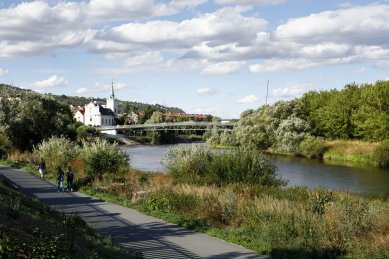
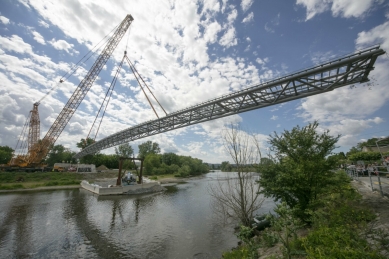
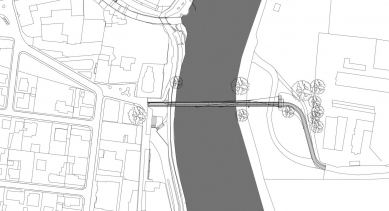
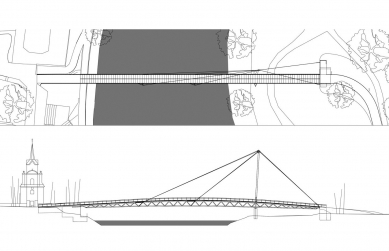
The axis of the 110 m long footbridge is straight in plan and bridges the Berounka from abutment O1 on the left (Radotín) bank across pier P2 to abutment O3 on the right (Zbraslav) bank. The deck level is shaped to meet height requirements with respect to the newly considered hundred-year flood level.
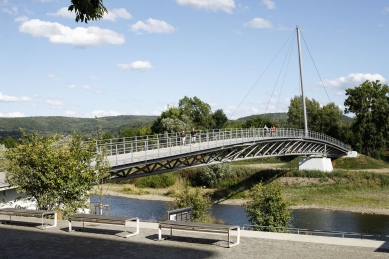
The role of the architect in bridge engineering is important not only from the perspective of urbanism and the shape and appearance of the structure. The architect's desire to design a structure with a single-pylon asymmetrical (sailboat-like) form brought an original, interesting, and surprisingly functional solution.
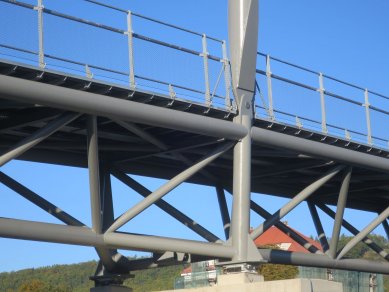
The placement of the asymmetrical single-pylon on the upper beam of the footbridge above the sliding bearing increased both the vertical and horizontal stiffness of the structure.
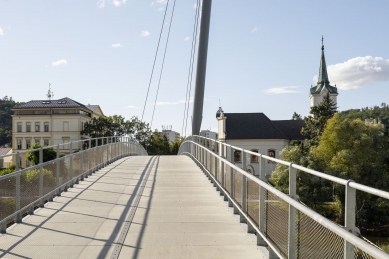
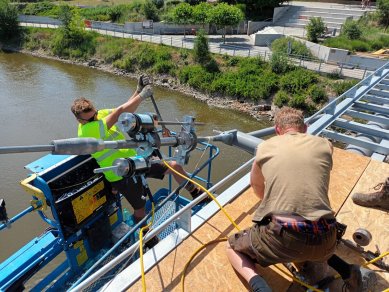
The termination of cable stays with a tensioning system allows for effective and precise tensioning of the stays using hydraulic devices along with strain gauge measurement, providing simple and aesthetic anchoring into the footbridge structure.
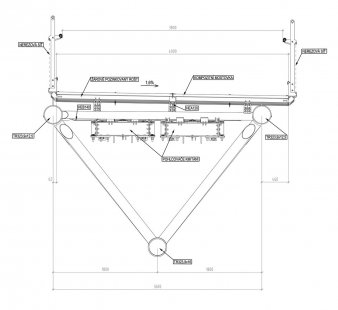
The removable composite deck on a hot-dip galvanized grid is a suitable alternative to wooden or orthotropic steel decks, especially in cases where a larger number of engineering networks are routed beneath the deck.
History of the footbridge
The original footbridge from 1994 had a post-tensioned bearing concrete structure with two spans suspended on one pylon over a pier located 30 m from the Zbraslav abutment. The footbridge, which had issues during construction, was deemed unsuitable in 2013 based on identified defects and was supported by two temporary piers in the river in 2014, along with other modifications. The proposed challenging reconstruction, involving the heightening of the pylon, anchoring the footbridge, and extensive modifications to the concrete structure itself, was not realized. Alternatively, a design for a new concrete suspension footbridge was developed, positioned outside the axis of the existing footbridge. Construction of the footbridge was never initiated due to two unsuccessful and canceled tender processes. The city district then requested architect Josef Pleskot to develop another solution, which later progressed to realization through design and build, significantly shortening the process before the construction began. In this variant, we placed a new steel structure on the existing reconstructed substructure, thus preserving the valuable shape and urbanistic solution of the footbridge, including widening the deck from 2.4 m to 4 m and significantly reducing investment costs compared to the alternatively proposed concrete suspension variant.
Layout and structural solution of the new footbridge
The axis of the 110 m long footbridge is straight in plan and bridges the Berounka from abutment O1 on the left (Radotín) bank across pier P2 to abutment O3 on the right (Zbraslav) bank. The deck level is shaped to meet height requirements with respect to the newly considered hundred-year flood level.
The role of the architect in bridge engineering is important not only from the perspective of urbanism and the shape and appearance of the structure. The architect's desire to design a structure with a single-pylon asymmetrical (sailboat-like) form brought an original, interesting, and surprisingly functional solution.
The placement of the asymmetrical single-pylon on the upper beam of the footbridge above the sliding bearing increased both the vertical and horizontal stiffness of the structure.
The termination of cable stays with a tensioning system allows for effective and precise tensioning of the stays using hydraulic devices along with strain gauge measurement, providing simple and aesthetic anchoring into the footbridge structure.
The removable composite deck on a hot-dip galvanized grid is a suitable alternative to wooden or orthotropic steel decks, especially in cases where a larger number of engineering networks are routed beneath the deck.
The English translation is powered by AI tool. Switch to Czech to view the original text source.
0 comments
add comment