
House under the walnut

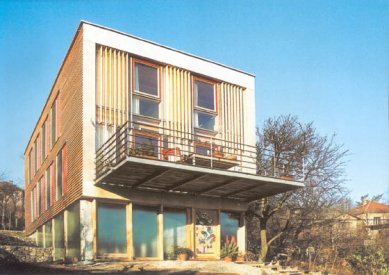
The fourteen-meter-wide plot of land (on the edge of the street line) narrows to twelve meters in depth. The height difference between the street and the entrance to the house is approximately 12 meters with a 15% slope of the terrain. Given the necessary functions that were to find their application here, the author divided the house into two distinct parts. However, both objects have a unified authorial handwriting, and the same construction materials, as well as similar architectural solutions for the facades, are used. From the street view, the studio is three stories high, while towards the garden, it is positioned so that the roof height barely exceeds the terrain.
The family house itself is situated about 30 meters from the street line, thus located in the background of the plot on its elevated spot with an east-west orientation and an attractive view of the eastern panorama of Bratislava. In this part, the plot was already so narrow that the width of the entire house does not exceed 7 meters. The floor plan of the house has a simple rectangular shape measuring 7 by 15 meters, on which individual spaces are arranged in a strict Cartesian spirit.
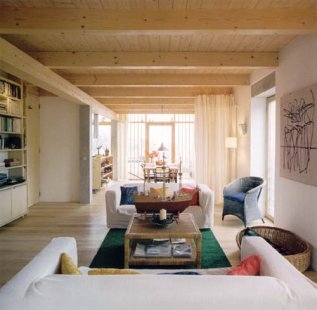
The ground floor is dedicated to the entrance areas, service facilities, and a large swimming pool hall. The main part of the house is situated on the first floor and utilizes almost the entire floor plan for one large living room divided into a kitchen, dining area, living area, and study. One level higher are the bedrooms of the children and parents with sanitary facilities. The clear, readable, and logical layout of the family house responds to the chosen form of the object, which the author assigned a decidedly primarily cubic box shape. The use of this elementary expressive means reveals the author's effort for a straightforward and unembellished expression. Although this form is somewhat rare in our country, abroad, it belongs to established principles representing contemporary European architectural trends.
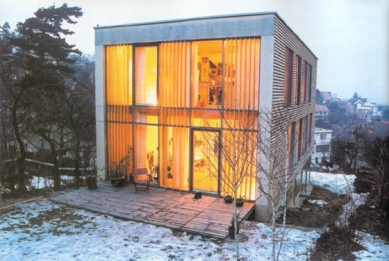
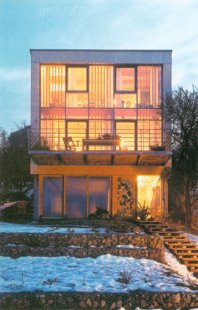
The author managed to create a pleasant and cozy house for living using simple expressive means. This is also due to the choice of materials in their "basic" form. Wood, glass, concrete, and metal are applied here without layers of additional coloring, refinement, or other seemingly aesthetic surface modifications. Wood and glass dominate. The eastern (visually more significant) and western (garden) facades have a fully glazed wall segmented by wooden slatted elements. The side (north and south) facades are dominated by a horizontal element of fir wood and French windows with atypical sliding metal sunshades. However, in relation to other surfaces, an unusually large amount of glass (approximately 140 m²) is used on the house, which creates a favorable effect of transparency of the individual spaces. The glazed eastern and western facades in the living room have an excellent spatial effect. The freely flowing linear space on one side "opens" directly into the garden, while on the other side, it continues to a terrace with an attractive view of the panorama of Bratislava. This spatial concept maximally utilizes the exterior collaboration of the surroundings of the house, which directly contributes to the spatial artistry of the interior. The garden greenery with mature trees and an old walnut thus became an integral part of the architectural concept. Along with the changing light conditions and the alternating seasons, the character of the living space also changes. The unusual transparency of the architecture thus creates an enhancement in the use of the house, providing its residents with a favorable connection with the exterior.
The house on Holubyho is different from the others on this street. Nevertheless, it fits in very well, thanks to its unequivocal form, openness, optimal size, and chosen materials.
... even though it is high ... it must be nice there.
The family house itself is situated about 30 meters from the street line, thus located in the background of the plot on its elevated spot with an east-west orientation and an attractive view of the eastern panorama of Bratislava. In this part, the plot was already so narrow that the width of the entire house does not exceed 7 meters. The floor plan of the house has a simple rectangular shape measuring 7 by 15 meters, on which individual spaces are arranged in a strict Cartesian spirit.
The ground floor is dedicated to the entrance areas, service facilities, and a large swimming pool hall. The main part of the house is situated on the first floor and utilizes almost the entire floor plan for one large living room divided into a kitchen, dining area, living area, and study. One level higher are the bedrooms of the children and parents with sanitary facilities. The clear, readable, and logical layout of the family house responds to the chosen form of the object, which the author assigned a decidedly primarily cubic box shape. The use of this elementary expressive means reveals the author's effort for a straightforward and unembellished expression. Although this form is somewhat rare in our country, abroad, it belongs to established principles representing contemporary European architectural trends.
The author managed to create a pleasant and cozy house for living using simple expressive means. This is also due to the choice of materials in their "basic" form. Wood, glass, concrete, and metal are applied here without layers of additional coloring, refinement, or other seemingly aesthetic surface modifications. Wood and glass dominate. The eastern (visually more significant) and western (garden) facades have a fully glazed wall segmented by wooden slatted elements. The side (north and south) facades are dominated by a horizontal element of fir wood and French windows with atypical sliding metal sunshades. However, in relation to other surfaces, an unusually large amount of glass (approximately 140 m²) is used on the house, which creates a favorable effect of transparency of the individual spaces. The glazed eastern and western facades in the living room have an excellent spatial effect. The freely flowing linear space on one side "opens" directly into the garden, while on the other side, it continues to a terrace with an attractive view of the panorama of Bratislava. This spatial concept maximally utilizes the exterior collaboration of the surroundings of the house, which directly contributes to the spatial artistry of the interior. The garden greenery with mature trees and an old walnut thus became an integral part of the architectural concept. Along with the changing light conditions and the alternating seasons, the character of the living space also changes. The unusual transparency of the architecture thus creates an enhancement in the use of the house, providing its residents with a favorable connection with the exterior.
The house on Holubyho is different from the others on this street. Nevertheless, it fits in very well, thanks to its unequivocal form, openness, optimal size, and chosen materials.
... even though it is high ... it must be nice there.
The English translation is powered by AI tool. Switch to Czech to view the original text source.
0 comments
add comment