
Four apartments in Laichter's house

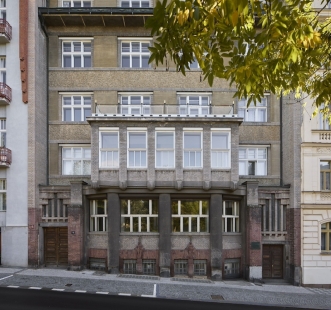
The house of the first-republic publisher Jan Laichter on Chopin Street in Prague's Vinohrady remains a living pearl of Czech modern architecture. Designers Johana Němečková and Barbora Kolerusová, during the reconstruction of four apartments, continued the story of the house. Through the interior designs, including an apartment for experiential overnight stays, they added a contemporary layer to the work of the renowned architect Jan Kotěra.
The house was built by Jan Laichter, a merchant's apprentice from Dobruška, who became one of the most significant Czech publishers. He founded the business bearing his name with his friend T. G. Masaryk, who could freely publish his writings there. The publishing house produced philosophical and scientific literature, as well as books for young people and students, enabling them for the first time in history to study in Czech.
The first modernist apartment building
Jan Laichter wished to combine work and family life under one roof in his new home in Vinohrady. He entrusted the realization of his vision to Jan Kotěra, the founder of modern architecture and teacher to an entire generation of architects from Josip Plečnik to Pavel Janák.
Thus, the very first modernist apartment building in the country was constructed on today's Chopin Street between 1908 and 1910. The publishing house operated on the ground floor while the family lived one floor above. The staircase hall connecting both spaces is still adorned with original elements such as stencil paintings and an original chandelier.
However, Laichter knew that such a house could not sustain itself. The four apartments in the building, also designed by Kotěra, served from the beginning for rent. The rent was used by Laichter to pay off the loan for the construction of the house. In the 1930s, his son František had a fourth floor added according to the design of Kotěra's pupil Pavel Janák.
Then came the year 1949. The law ensuring the dominance of communist ideology destroyed over three hundred private publishing houses. Trucks transported ten tons of books, more than 27 thousand volumes, from Laichter's house to the incinerator. In 1961, the family was forcibly evicted. The house was regained only after the revolution.
The same principle, a different time
"I feel a sense of vindication against the communist regime that attempted to destroy everything, and I want to show that they failed," says thirty-one-year-old Štěpán Lars Laichter, who currently manages the house.
He faced the same problem as his great-great-grandfather: How to pay for the restoration of the most valuable spaces? He found the answer where Jan Laichter once did. The income from the renovated and rented apartments now finances the restoration of historical interiors and cultural events held in the house.
Two designers in dialogue with Kotěra and Janák
Regarding the apartment reconstruction proposal, Štěpán reached out to Johana Německá and Barbora Kolerusová from the studio Other Projects. Both met during their studies at UMPRUM, where they co-founded the Óda brand, through which they transferred traditional craftsmanship elements into contemporary design. Their sensitive approach to materials, respect for historical crafts, and ability to interpret them in a modern context were the main reasons for choosing them.
The designers were tasked with proposing the reconstruction of four apartments. Two by Jan Kotěra and two by Pavel Janák. The assignment was to design interiors that would work for contemporary living while also highlighting the details and language with which the interiors were designed by Kotěra and Janák. No revolution, but also no sentimentality. A new layer, aware of all previous ones, reflecting their value.
"In Laichter's house, it's about finding a compromise when to return the original object and when to enhance the space with a modern element that reflects its historical context," explains Štěpán. The designers approached each apartment slightly differently because each had different original uses, different architects, and different characters. However, the individual reconstructions are connected by respect for the material and the courage to let what was already in the house speak.
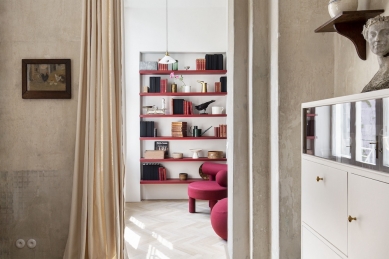
On the first floor is the Washroom – an apartment for experiential overnight stays. It was once the laundry and the small room of the maid Mařenka, where the children of the family used to play. After the renovation, a reading nook with a library was created above, where, alongside volumes from the 1950s, stand empty books reminiscent of those burned by the communists. Below, a generous bathroom with a sauna and a view of the garden was accommodated. When the designers removed the pink latex from the walls, they discovered the original plaster underneath. Dented but beautiful. The individual layers of paint left a map of transformations over time.
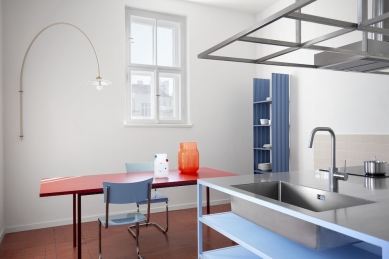
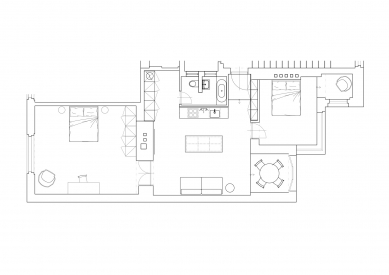
On the third floor, Kotěra's apartment is still available for rent. The designers restored the stencil painting in the hallway based on period photographs along with a grand coat rack wall shape-inspired by Kotěra's work. They also took the liberty to use red paint for the hallway, with a wardrobe in the same color. The new kitchen seemed to be a puzzle since the original furnishings did not survive. The design ultimately draws stylistically and materially from Kotěra's furniture but incorporates modern functional elements. "We are not transforming the face of the house. We are creating another layer. The sediment of the present," summarize Johana and Barbora.
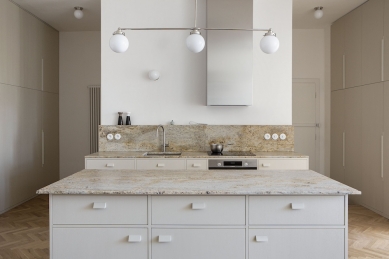
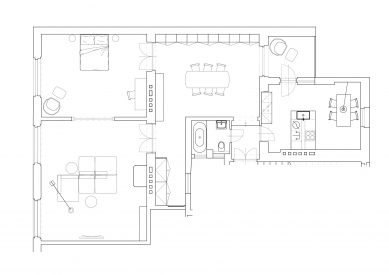
The fourth floor was conceived by the designers as a dialogue with the extension, whose author had long been unknown. It was only through archival documents that Laichter's great-great-grandson discovered that it was Pavel Janák. Janák added the floor with such humility that passersby hardly notice it from the street even today. The designers maintained the same approach: a new layer that does not seek to be seen but is felt. One of the apartments features a custom library inspired by the shapes from the work of Kotěra and Janák, while the other has a generous kitchen island.
Johana photographed all the interiors herself. Her images capture exactly what they were trying to create: a space where the accumulations of the second half of the twentieth century yield to the renewal of original elements and the stories they tell.
A vision for the next hundred years
The house is currently more alive than it has been since the revolution. Author readings, book launches, exhibitions, and educational workshops for schools take place there. The staircase hall, which the communists turned into an empty space, is once again fulfilling the role intended by Kotěra: connecting private life with cultural life. The writing room, where manuscripts were once edited, now hosts literary events. The salon and dining room open to the public during cultural events and tours. The restoration of these spaces continues gradually, financed specifically by the income from the renovated apartments.
Laichter's house enters its second century in the hands of the family that built it, lost it, and regained it. The economic model remains the same. The apartments serve the house. And the house serves culture.
The house was built by Jan Laichter, a merchant's apprentice from Dobruška, who became one of the most significant Czech publishers. He founded the business bearing his name with his friend T. G. Masaryk, who could freely publish his writings there. The publishing house produced philosophical and scientific literature, as well as books for young people and students, enabling them for the first time in history to study in Czech.
The first modernist apartment building
Jan Laichter wished to combine work and family life under one roof in his new home in Vinohrady. He entrusted the realization of his vision to Jan Kotěra, the founder of modern architecture and teacher to an entire generation of architects from Josip Plečnik to Pavel Janák.
Thus, the very first modernist apartment building in the country was constructed on today's Chopin Street between 1908 and 1910. The publishing house operated on the ground floor while the family lived one floor above. The staircase hall connecting both spaces is still adorned with original elements such as stencil paintings and an original chandelier.
However, Laichter knew that such a house could not sustain itself. The four apartments in the building, also designed by Kotěra, served from the beginning for rent. The rent was used by Laichter to pay off the loan for the construction of the house. In the 1930s, his son František had a fourth floor added according to the design of Kotěra's pupil Pavel Janák.
Then came the year 1949. The law ensuring the dominance of communist ideology destroyed over three hundred private publishing houses. Trucks transported ten tons of books, more than 27 thousand volumes, from Laichter's house to the incinerator. In 1961, the family was forcibly evicted. The house was regained only after the revolution.
The same principle, a different time
"I feel a sense of vindication against the communist regime that attempted to destroy everything, and I want to show that they failed," says thirty-one-year-old Štěpán Lars Laichter, who currently manages the house.
He faced the same problem as his great-great-grandfather: How to pay for the restoration of the most valuable spaces? He found the answer where Jan Laichter once did. The income from the renovated and rented apartments now finances the restoration of historical interiors and cultural events held in the house.
Two designers in dialogue with Kotěra and Janák
Regarding the apartment reconstruction proposal, Štěpán reached out to Johana Německá and Barbora Kolerusová from the studio Other Projects. Both met during their studies at UMPRUM, where they co-founded the Óda brand, through which they transferred traditional craftsmanship elements into contemporary design. Their sensitive approach to materials, respect for historical crafts, and ability to interpret them in a modern context were the main reasons for choosing them.
The designers were tasked with proposing the reconstruction of four apartments. Two by Jan Kotěra and two by Pavel Janák. The assignment was to design interiors that would work for contemporary living while also highlighting the details and language with which the interiors were designed by Kotěra and Janák. No revolution, but also no sentimentality. A new layer, aware of all previous ones, reflecting their value.
"In Laichter's house, it's about finding a compromise when to return the original object and when to enhance the space with a modern element that reflects its historical context," explains Štěpán. The designers approached each apartment slightly differently because each had different original uses, different architects, and different characters. However, the individual reconstructions are connected by respect for the material and the courage to let what was already in the house speak.
On the first floor is the Washroom – an apartment for experiential overnight stays. It was once the laundry and the small room of the maid Mařenka, where the children of the family used to play. After the renovation, a reading nook with a library was created above, where, alongside volumes from the 1950s, stand empty books reminiscent of those burned by the communists. Below, a generous bathroom with a sauna and a view of the garden was accommodated. When the designers removed the pink latex from the walls, they discovered the original plaster underneath. Dented but beautiful. The individual layers of paint left a map of transformations over time.
On the third floor, Kotěra's apartment is still available for rent. The designers restored the stencil painting in the hallway based on period photographs along with a grand coat rack wall shape-inspired by Kotěra's work. They also took the liberty to use red paint for the hallway, with a wardrobe in the same color. The new kitchen seemed to be a puzzle since the original furnishings did not survive. The design ultimately draws stylistically and materially from Kotěra's furniture but incorporates modern functional elements. "We are not transforming the face of the house. We are creating another layer. The sediment of the present," summarize Johana and Barbora.
The fourth floor was conceived by the designers as a dialogue with the extension, whose author had long been unknown. It was only through archival documents that Laichter's great-great-grandson discovered that it was Pavel Janák. Janák added the floor with such humility that passersby hardly notice it from the street even today. The designers maintained the same approach: a new layer that does not seek to be seen but is felt. One of the apartments features a custom library inspired by the shapes from the work of Kotěra and Janák, while the other has a generous kitchen island.
Johana photographed all the interiors herself. Her images capture exactly what they were trying to create: a space where the accumulations of the second half of the twentieth century yield to the renewal of original elements and the stories they tell.
A vision for the next hundred years
The house is currently more alive than it has been since the revolution. Author readings, book launches, exhibitions, and educational workshops for schools take place there. The staircase hall, which the communists turned into an empty space, is once again fulfilling the role intended by Kotěra: connecting private life with cultural life. The writing room, where manuscripts were once edited, now hosts literary events. The salon and dining room open to the public during cultural events and tours. The restoration of these spaces continues gradually, financed specifically by the income from the renovated apartments.
Laichter's house enters its second century in the hands of the family that built it, lost it, and regained it. The economic model remains the same. The apartments serve the house. And the house serves culture.
Nikola Lörinczová, PIARISTI
The English translation is powered by AI tool. Switch to Czech to view the original text source.





0 comments
add comment