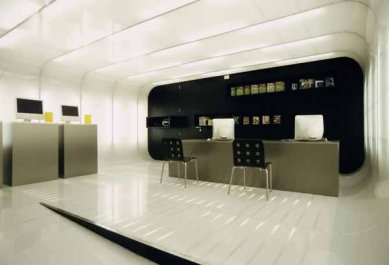
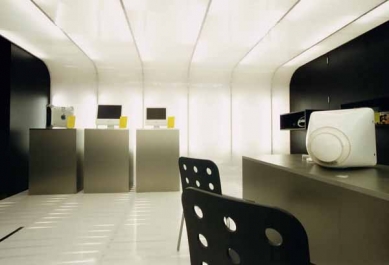
The interior is designed for the presentation and sale of computing technology, primarily the brand
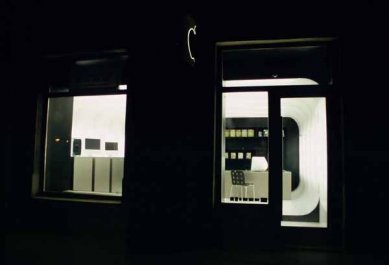
APPLE. In the design, we took into account that the investor is a dynamically developing company and its activity involves the sale and service of branded computers. The interior was created as an object inserted into the ground floor of the building. It can function independently if needed. It is possible to disassemble it and, similarly to computers, relocate it to another space of similar volume. The shape is inspired by the computer phenomenon APPLE Macintosh, currently the most powerful model G5. The synthetic machine treatment and the chosen materials stem from the philosophy of the brand. Upon entering, the customer finds themselves within the machine, drawn into the world of computers. The supporting structure consists of wooden frames anchored to the surrounding walls, floor, and ceiling. The frames are clad in opal polycarbonate with a thickness of 3mm and a light transmittance of 35%. Between these panels and the surrounding structures, there is space for the placement of lighting fixtures and cable distribution. The polycarbonate panels on the floor are laid on a wooden grid. The panels are screwed into the frame, utilizing their exceptional properties - strength, hardness, and the ability to bend cold. The walls and ceiling are reinforced with glued ribs made from the same material. During the day, if the lights are off, this shell is perceived as solid, white, slightly translucent, and reflecting the devices inside. The structure of the supporting frames can only be guessed. When the lights are on (74 fluorescent lights placed behind the polycarbonate shell), the supporting structure of the frames is marked on the surface. The back and front walls, including the doors connecting the showroom to the rear office, are made of MDF panels covered with black HPL foil. Two workstations were established - counters, which are analogous to the two processors of the G5 computer. The counters and exhibition pedestals are made from laminate panels coated on one side with a stainless steel layer.
The English translation is powered by AI tool. Switch to Czech to view the original text source.




.jpg)